Get Full Government Meeting Transcripts, Videos, & Alerts Forever!
Get email alerts on the Economic Development topic
No spam. Unsubscribe anytime.
Rutland aldermen approve TIF district plan, authorize application to state economic council
Summary
The Board of Aldermen voted to establish a tax increment financing district and authorized submission of the application to the Vermont Economic Progress Council; the plan identifies roughly $20.6 million in infrastructure projects and an initial hotel project as likely early phases.
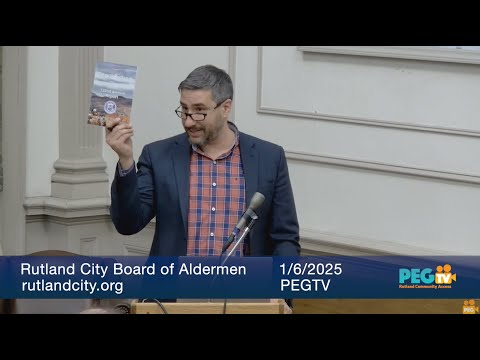
The Rutland City Board of Aldermen on Jan. 6 approved a tax increment financing (TIF) district plan and authorized staff to submit the city’s application to the Vermont Economic Progress Council (VEPC).
The vote, taken after a presentation and discussion, authorizes the mayor and board president to sign and submit the district application and begins the formal process that could let the city use incremental tax revenue from new development to pay for specified infrastructure improvements.
The plan, presented by Stephanie Clark, a consultant with Weitenberg Real Estate Advisors, describes the district as a small downtown area and identifies roughly $20,600,000 in potential infrastructure investments. Clark said the consultant team identified 11 conceptual private projects that could be unlocked by eight categories of public infrastructure work; the consultant estimated those changes could yield about 385 new housing units and about $60 million in increased property value over time.
"Tax increment financing is a way to reduce barriers for private development," Stephanie Clark said. "During the life of the TIF district, any new property value created will go toward paying down the debt." She explained that the district would be created as of April 1 if the board’s action is certified and that the city then has 10 years to incur debt for projects and, from the first debt, up to 20 years to capture increment until obligations are repaid.
Mayor Mike Dunges and Planning & Zoning Administrator Beau introduced the presentation and thanked working-group members and city staff who participated in planning and financial modeling. Clark said the application the board authorized for submission is a "master" TIF district plan — a menu of possible projects rather than a binding commitment to specific contracts or bonds. She said no debt is being authorized tonight.
Board members asked procedural questions about state oversight and local administration. Alderman McCann asked whether accounting and distribution of funds would be handled by the state. Clark replied that the city treasurer would perform local accounting and the state will review and oversee the program through VEPC.
Alderman Taddio moved to suspend the rules and take the matter up that night; the motion was seconded and passed. Taddio then moved to approve the TIF district plan, adopt the resolution establishing the district, circulate it for signature, and authorize submission of the application to the Vermont Economic Progress Council. The motion was seconded and passed by voice vote.
The presentation noted the district’s likely early focus: Clark said the working group intends to pursue a hotel project as the city’s first phase filing and to file for a special bond vote in the fall if the phase filing and state approvals align. Clark cautioned the board that VEPC may request edits to the application during its review and that the city would return to the board for specific development agreements, phase filings, and any bond votes; she emphasized that creating the district does not by itself incur project debt.
Why it matters: A TIF district would let Rutland use a portion of new property taxes from development inside the district to finance infrastructure that proponents say is needed to unlock private investment, housing development and downtown revitalization. Clark’s materials projected roughly $3 million in additional general-fund revenue and about $6.8 million to the education fund over 20 years, contingent on the conceptual projects and market outcomes.
Next steps: The board authorized submission of the application to VEPC; Clark said VEPC staff would likely visit Rutland in late February for an in-person review and that the city would continue concurrent work on the first project’s phase filing and development agreements before any bond or debt is incurred.