Get Full Government Meeting Transcripts, Videos, & Alerts Forever!
Get email alerts on the Land Use Development topic
No spam. Unsubscribe anytime.
Fort Myers Beach council advances Pink Shell CPD to second reading after contentious hearing
Summary
After hours of testimony and legal review of century-old covenants, the Town Council voted 3–1 with one abstention to advance a proposed Pink Shell commercial planned development (CPD) rezoning to a second reading, conditioning review of public benefits and retaining opportunity for further input.
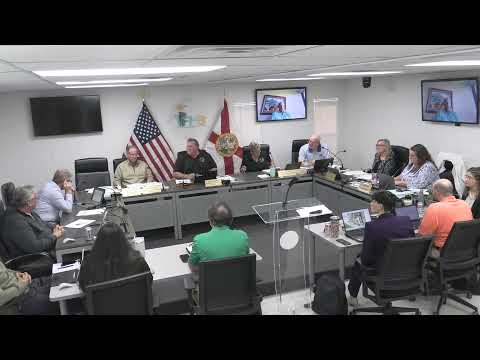
The Town Council of Fort Myers Beach voted 3–1, with one abstention, on Jan. 8 to advance the first reading of an ordinance to rezone roughly 6.02 acres of the Pink Shell properties into a unified commercial planned development and to allow a new 40-unit boutique hotel and related deviations. The vote sends the ordinance to a second reading and public hearing on Feb. 3, 2025.
The proposal prompted more than two hours of testimony and expert presentations at the quasi-judicial hearing. The applicant, represented by land-use attorney Amy Tubow and a team of planning and architecture experts, described changes made since the Local Planning Agency review to reduce building mass, remove a proposed public parking element on the gulf side, and revise setbacks and public-benefit commitments. Staff recommended conditional approval only if the council found the proposed public benefits adequate to justify deviations for height and equivalency factors.
Opponents and public commenters focused on whether historically recorded documents and a 2000 resolution and restrictive covenant removed development rights from certain Bayside parcels. Several residents and former local officials told council they understood the earlier actions to have preserved the Bayside parcels from future development. The applicant’s attorney and planner pointed to recorded legal descriptions and the amended 2000 zoning resolution and argued those documents do not encumber the two boutique-hotel parcels, allowing the applicant to request development within the CPD process.
Council members and staff discussed technical issues including equivalency factors (the code’s hotel-unit multiplier), floor-area ratio, setbacks, stormwater, parking and pedestrian access. The application asks council to apply an increased hotel equivalency multiplier (proposed 6.7) across the unified CPD to achieve a total of 239 guest units across the resort; staff and the applicant said the proposal would remain under the comp-plan floor-area-ratio limit and meet parking requirements as designed.
The applicant outlined public benefits the project would deliver as part of the trade-off for deviations: a new and enlarged interpretive boardwalk and landscaping along the Bayside, enhanced public access and public parking elements on the bayside, continued pump-out service for the anchorage/mooring field, coordinated stormwater improvements, and donations or in-kind commitments for Bay Oaks programs. The town attorney and staff said specific financial values and commitments should be captured in conditions of approval and cited the need for concrete, enforceable commitments before the second reading.
After public comment concluded, Councilor Scott Safford moved to advance the ordinance to a Feb. 3 second reading. Councilor John King seconded. The roll call voice vote recorded Councilors Safford, King and Vice Mayor Aderhold as voting yes; Councilor Woodson voted no; Councilor Mary Allers abstained. The motion carried 3–1 with one abstention.
Council members said they wanted more specific documentation of the public benefits and cost estimates before the final vote. Council asked staff and the applicant to provide written values and binding conditions for the pump-out service, the interpretive walkway improvements, stormwater actions and any public-parking commitments before the second reading. The applicant said in open remarks that several commitments would be memorialized and that the project team would provide cost estimates and draft condition language in the coming weeks.
The ordinance advancement does not authorize permits or construction; it moves the CPD to a legally required second reading where the council will consider final findings, conditions and the written records about public benefit adequacy. The Feb. 3 hearing will be the council’s next opportunity to take final action to approve, modify or deny the requested CPD and deviations.
The council also received requests from a number of residents that town staff pursue clarity about historical documents that created the Bayside development rights; the applicant and staff provided copies of recordings and mappings to the council at the hearing and committed to post the referenced records in the project file for public inspection before the second reading.
The council’s action advances a high-profile development conversation that councilors and many residents said will shape the future balance of tourism and residential character on Fort Myers Beach.
Looking ahead, the council set the second reading and final public hearing for Feb. 3, 2025 at 9 a.m. Staff and the applicant were directed to exchange written draft conditions and to submit concrete cost estimates for the public-benefit items discussed in the hearing.