
Three teams pitch mixed‑use, transit‑oriented concepts for Cary’s Maplewood site; board to continue review
Get AI-powered insights, summaries, and transcripts
Sign Up Free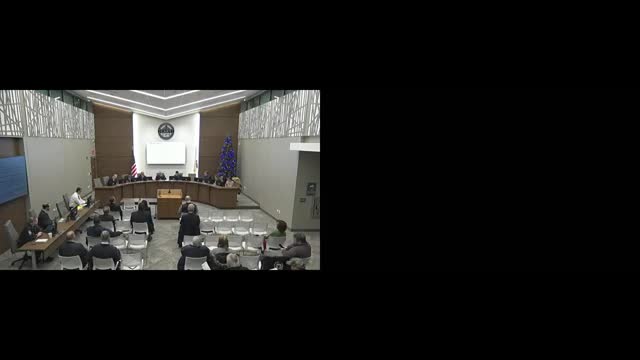
Summary
Three development teams presented competing plans for the Village of Cary’s Maplewood property on Jan. 7. Proposals ranged from about 250 to nearly 300 market‑rate rental units plus townhomes, community park space and parking strategies; the board made no selection and staff will continue negotiations and studies.
Three development teams presented concepts for the Village of Cary’s Maplewood property during an informational session on Jan. 7, 2025, outlining plans that would add roughly 250–300 market‑rate rental units and between about 44 and 50 townhomes while reserving space for a public park and stormwater detention.
The presentation session was informational only; no developer was selected. Brian, a village staff member, opened the agenda item by telling the board the goal was to introduce the teams and gather feedback: “This is informational only,” he said.
Why it matters: The Maplewood site is currently the Cary School District 26 transportation center under an intergovernmental agreement that allows the district to remain on the site until a new facility is built, after which the village can market the property for private development. Any redevelopment would require a redevelopment agreement, village entitlement steps and public hearings, and will affect traffic, stormwater detention and the village’s downtown transition plans.
What the teams proposed
- Courtigan Clark / JTE joint venture presented a transit‑oriented concept that centers five‑story apartment blocks near the rail line, buffered on the edges by three‑story townhomes. The team described two parking scenarios: a 2.0 spaces‑per‑unit ratio in an initial option and a reduced 1.5 ratio in an alternate that saved surface parking and created more green open space. John Courtigan, principal architect of Courtigan Clark and a partner in JTE, said the proposal would “help downtown grow” and called the project “a fabulous opportunity both for our development team, but also as well as the village of Cary.” Trustee questions during the presentation confirmed the team’s early sizing: roughly 160 rental units plus about 50 townhomes in the concept shown.
- The Linmark Group proposed two five‑story apartment buildings totaling about 288 units and about 44 townhomes, with an amenity‑rich courtyard and a parking ratio the team calculated at roughly 1.45 spaces per unit. “I thought it had the most potential,” Bridal Friedman, director of Midwest operations for Linmark, said of the Maplewood site. Linmark’s renderings emphasized balconies for every apartment, a connected amenity clubhouse and a courtyard with pool, fire pits and grills. The firm said it operates properties long term and highlighted Wheeling Town Center as a local example.
- VDR/Charles Hall (Sterling Hall team) pitched a mixed plan with 284 market‑rate units in a mix of two‑story “direct‑entry” buildings (each with private garages) and four‑story elevator buildings. The team emphasized onsite detention needs and showed a large central surface detention basin (about 2.34 acres in the concept) and a 0.3‑acre public park in the southwest corner the team said it could dedicate to the village. The VDR team provided specific stormwater figures during the presentation: total detention modeled at about 8.501 acre‑feet using the newer Bulletin 76 rainfall values, and noted off‑site work could reduce on‑site detention needs.
Common themes and technical issues
All three teams framed Maplewood as a transit‑oriented opportunity because of the site’s proximity to the rail corridor and downtown walkability. Parking ratios, covered parking and EV charging were recurring topics: some trustees and residents pressed for more protected/indoor parking while developers noted tradeoffs between garages and project economics. The Courtigan team explicitly added electric vehicle charging and internalized much of the surface parking in its option 2.
Stormwater and access: VDR’s presentation put stormwater detention at the center of technical constraints. The developer said existing outfalls and a culvert beneath the railroad limit available storage depth and drive much of the design for a large surface basin unless off‑site infrastructure is improved. Trustees and staff repeatedly referenced the Maplewood access road project (a separate village roadway effort) and said any redevelopment would need to coordinate closely with that roadway, fire protection access and utility work.
Unit mix and affordability: Linmark and other presenters proposed unit mixes that include studios, one‑bedroom and two‑bedroom units; Linmark’s slide showed 20% studios, 40% one‑bedroom and 40% two‑bedroom for its 288‑unit plan. Several trustees and residents asked about studio units and smaller one‑bedroom sizes (developers suggested 550–650 square feet for some one‑bedroom units) as a way to broaden local rental opportunities.
Public reaction and board concerns
A number of residents who spoke during public comment urged more owner‑occupied housing and raised concerns about traffic, school impacts, drainage and the village character. Linda Stell, a resident who testified earlier in the meeting about tree clearing at 268 Stonegate Road, later told the board she wants stronger tree preservation rules in town. Other residents warned that a large number of new apartment units could increase congestion and asked the board to preserve downtown character and neighborhood transitions.
Trustees repeatedly asked developers about community engagement and whether plans could be refined in response to neighborhood input. Developers answered that they would hold focus groups and community meetings if chosen to proceed and that some design elements (building orientation, townhouse frontage, parking locations) were still negotiable.
Next steps
Brian told the board staff will continue conversations with the developers, evaluate the proposals and return later with a recommendation for a preferred developer team. Any selection would be followed by negotiation of a redevelopment agreement, third‑party technical reports (traffic, stormwater, soils), formal PUD/zoning and public hearings before the village board.
No formal approvals or redevelopment agreements were made at the Jan. 7 meeting; the presentations were expressly informational only.