Get Full Government Meeting Transcripts, Videos, & Alerts Forever!
Get email alerts on the State Legislation Hb581 topic
No spam. Unsubscribe anytime.
Villa Rica staff outlines timeline, trade‑offs of Georgia’s House Bill 581; council plans public hearings before March deadline
Summary
City staff presented House Bill 581’s floating homestead exemption and the related “FLOST” sales‑tax option, outlined a tentative public‑hearing schedule and recommended starting the opt‑out process so the city meets a March 1 deadline to file a resolution if it chooses to opt out.
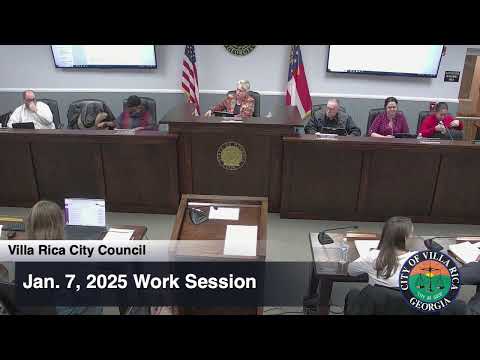
Villa Rica interim city manager Diana DeSanto told the council at a work session that House Bill 581, passed by the Georgia General Assembly in 2024 and signed by Gov. Brian Kemp on April 18, 2024, creates a statewide “floating” homestead exemption and a new local sales tax option intended to offset property‑tax reductions.
DeSanto said the floating homestead exemption would limit how much a home’s taxable value can rise in any year by tying the allowed increase to an inflation measure set by the state revenue commissioner. “Homeowners that have already granted a homestead will receive this exemption automatically if we choose not to opt out,” she said, explaining the exemption applies to local governments that accept it.
The bill also authorizes a new local option called a FLOST (floating local option sales tax). If a local governing authority keeps the floating homestead exemption in effect, the jurisdiction may seek voter approval for up to 1 percentage point of sales tax to replace property‑tax revenue lost to the exemption. DeSanto said the FLOST is a separate referendum voters must approve; if a jurisdiction does not get the referendum vote it will not receive the sales‑tax proceeds.
DeSanto summarized two timing and process constraints for Villa Rica: (1) the city must complete a formal opt‑out process and file a resolution with the Georgia Secretary of State by March 1, 2025 if it chooses to opt out of the statewide floating homestead exemption; and (2) the FLOST, if pursued later, would be offered by referendum in 5‑year increments and only where the county and all cities that levy property taxes on that county side participate.
Because Villa Rica sits in two counties (Carroll and Douglas), DeSanto warned council members that eligibility for a FLOST would be determined separately for each county side. “If any city in a county opts out, the county and all cities within that county are ineligible for the FLOST,” she said. She described intergovernmental negotiations that would be needed to divide any sales‑tax proceeds and noted local allocation rules would be similar to existing LOST (local option sales tax) negotiations.
DeSanto presented a tentative schedule staff recommended to satisfy the March 1 filing requirement while allowing public input: a first public hearing on Jan. 21 at 6 p.m., a second public hearing on Feb. 4 at the 10 a.m. work session, and a final hearing and potential vote on Feb. 11 at 6 p.m. She said the agenda notices and newspaper ads must meet statutory requirements (three hearings; advertising with specific language; one hearing between 6 p.m. and 7 p.m.), and that staff will post the presentation material on the city website and circulate a fact sheet.
Council members pressed staff for analysis of how the measure could affect city finances over time. Councilman McCoy asked whether staff could model the millage‑rate implications “if this had been in effect for prior years” to show the likely impact on revenue and required rollback decisions; DeSanto agreed to prepare estimates using past reassessment histories. Councilman Montahan and others also asked for scenario work showing the combined effect of the floating exemption and a potential FLOST (if a referendum passed) on the city’s operating budget and on special districts such as the Tax Allocation District (TAD).
DeSanto told the council the short‑term fiscal impact would likely be limited because the base year for the exemption would be the 2024 digest; “where it will matter is down the road,” she said, when taxable values continue to change but the allowed taxable‑value increase would be capped by the inflation adjustment determined by the state.
DeSanto emphasized the choice is procedural and reversible only under narrow paths: the council can opt out by resolution by March 1, or the local legislative delegation could pursue a local act of the General Assembly at a later date. She recommended starting the opt‑out advertising and hearings now to preserve options and buy time for analysis and neighbor‑jurisdiction coordination. “This allows us to follow the timeline, and then give us more time to see what other cities are doing,” she said.
Council members did not take a final vote at the work session. Staff said it would publish the presentation online, circulate a one‑page fact sheet, and return to the council with modeling that compares revenue outcomes under opt‑in and opt‑out scenarios, and with updated information from Carroll and Douglas County governments and neighboring cities.
Why it matters: House Bill 581 alters the mechanism that determines taxable values on owner‑occupied homes and creates a new local sales‑tax tool to offset property‑tax revenue changes. The law affects the city’s ability to tax rising residential values and could change how much revenue the city collects or must replace over time. The March 1 deadline sets a short calendar for public hearings and a council decision about whether to accept the statewide rule or opt out and preserve local taxing authority.
Next steps: Staff will post the presentation and fact sheet on the city website, schedule the statutory public hearings (Jan. 21, Feb. 4, Feb. 11 as proposed), and return with millage‑rate and revenue scenarios and updates on actions by Carroll and Douglas County and neighboring cities.