Get Full Government Meeting Transcripts, Videos, & Alerts Forever!
Get email alerts on the Public Safety Recruitment topic
No spam. Unsubscribe anytime.
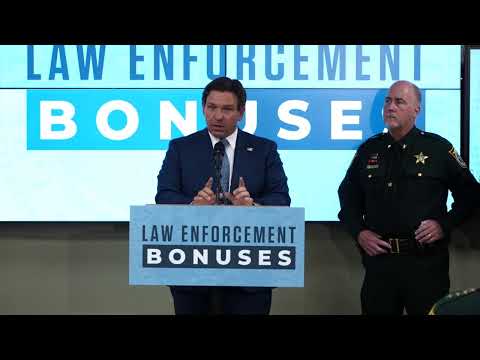
DeSantis marks milestone in Florida law-enforcement recruitment bonus program in Bay County
Summary
Governor Ron DeSantis on Wednesday presented recruitment-bonus checks to Bay County deputies and said Florida has awarded ‘‘over 9,400 bonuses throughout this program,’’ each worth $5,000 after taxes, part of roughly $63 million distributed to date.
Governor Ron DeSantis on Wednesday presented recruitment-bonus checks to Bay County deputies and said Florida has awarded ‘‘over 9,400 bonuses throughout this program,’’ each worth $5,000 after taxes, part of roughly $63 million distributed to date.
DeSantis told a crowd of law enforcement leaders and recruits that the payments are intended to boost recruitment, retain officers and improve morale across Florida, including in fiscally constrained rural counties. He credited state pay increases for law enforcement and a 15% boost to veteran officers as part of broader support for public safety.
The announcement came at a Bay County event hosted by Sheriff Tommy Ford. Ford told the crowd that DeSantis has ‘‘shown up for Bay County’’ since Hurricane Michael and credited the governorwith pay and recruitment incentives that have helped the county attract more than 40 deputies who received the recruitment bonus. Sheriff Mike Harrison of Gulf County described state programs such as LEAP, the law enforcement apprenticeship program, as essential for counties that cannot afford to pay recruits while they train.
DeSantis described multiple program elements: academy scholarships that cover tuition and up to $1,000 of eligible training expenses for trainees enrolled in basic recruitment training; a $5,000 after-tax bonus for new recruits and transfers; and state efforts to raise base pay for agencies such as the Florida Highway Patrol and the Florida Department of Law Enforcement. He said about 2,000 of the bonus recipients came from out of state and that another ‘‘734 more in the mail’’ were on their way to law enforcement officers across Florida.
Bay County deputy Arnaldi Barrett Eisenberger, who emigrated from Jamaica, described the state support as life changing and said she benefitted from local tuition assistance and the state-funded training pipeline that allowed her to move from corrections into a sworn role. ‘‘Iam living proof,’’ Eisenberger said, recounting how local and state programs paid her tuition and helped her finish academy training.
DeSantis framed the initiatives as part of a broader law-and-order agenda, saying Floridahas rejected calls to defund police and has passed legislation to prevent municipal defunding of police. He also said the state has boosted pay and training incentives to avoid losing officers to other jurisdictions.
Names announced by the stage party as recipients included: Arnaldi Barrett Eisenberger (Bay County Sheriff's Office); Joshua Nelson (Bay County Sheriff's Office); Mason Irons (Lynn Haven Police Department); Steven McAleny (Franklin County Sheriff's Office); Zachary Ake (Gulf County Sheriff's Office); Chelsea Higdon (Gulf County Sheriff's Office); Samuel Bridal (Walton County Sheriff's Office); Kelby Drake (Walton County Sheriff's Office); Samuel Helms (Walton County Sheriff's Office); and John Rahiotis (Walton County Sheriff's Office). DeSantis presented checks onstage during the event.
Officials at the event also said state programs such as LEAP (law enforcement apprenticeship program) and state salary-assistance measures for fiscally constrained counties have allowed smaller sheriff's offices to compete with larger jurisdictions for recruits.
DeSantis repeatedly tied recruitment efforts to broader public-safety policy, saying state-level law-and-order measures must be paired with well-funded, well-trained officers on the ground. He also noted that Florida is advertising the program as a recruitment incentive to officers from jurisdictions where he said morale and support have declined.
No formal votes or policy adoptions were recorded at the event; the governor and local officials presented awards and described existing and proposed state supports for law enforcement.
The event concluded after additional check presentations and brief questions from the audience about federal government operations and possible impacts on state agencies.