Get Full Government Meeting Transcripts, Videos, & Alerts Forever!
Get email alerts on the Criminal Procedure topic
No spam. Unsubscribe anytime.
Appeals court questions hotel-search law in Kearney suppression appeal
Summary
The Massachusetts Appeals Court heard arguments over whether hotel staff telling police they did not permit firearms in a room justified officers’ warrantless entry. Defense counsel urged reliance on Stoner v. California; the Commonwealth urged applying Commonwealth v. Molina. The court took the case under advisement.
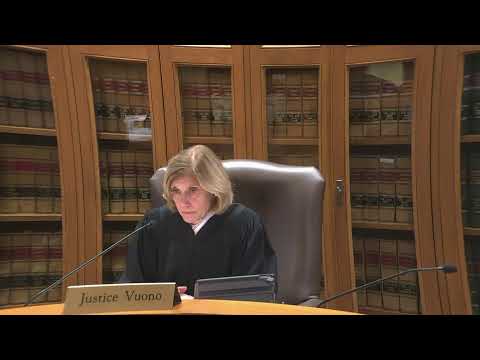
A three-justice panel of the Massachusetts Appeals Court heard argument in Commonwealth v. Thomas Kearney over whether police lawfully entered a hotel room after hotel staff told officers the hotel did not permit firearms.
The panel — which the bench introduced as consisting of Justice Ariane Bueno, Justice Rachel Hershfang and Justice Gloria Tam — heard conflicting legal arguments about notice and exigent circumstances. Attorney Jack P. Milgram, representing the appellant Thomas Kearney, argued the search should be suppressed because there was no evidence the defendant received actual or constructive notice that his hotel tenancy had been terminated before officers entered the room. Milgram urged the court to follow Stoner v. California, 376 U.S. 483 (1964), saying Stoner is “on point” and that the facts showed no consent or prior notice to the guest.
The Commonwealth, represented by Assistant District Attorney David McGowan, urged the court to apply Commonwealth v. Molina, 459 Mass. 819 (2011). McGowan argued that Molina’s discussion of guests’ reduced expectation of privacy after admitting criminal activity applied where, he said, the defendant admitted to officers that he had an illegal firearm and the hotel informed police of a no-firearms policy. “At that point in time, the majority opinion in Molina applies,” McGowan told the panel, saying the defendant’s admissions meant he lacked an objectively reasonable expectation of privacy in the room.
Defense counsel also disputed the Commonwealth’s fallback theory that exigent circumstances justified the entry. Milgram argued officers could have “frozen” the room and obtained a warrant, and he contended the record lacked the urgency shown in cases the Commonwealth cited.
Justices pressed both sides on the distinction between constructive notice created by hotel policies and a guest’s actual awareness of a hotel’s rules. The panel asked whether Molina requires the guest to have knowledge of a hotel’s policy and questioned how factual differences between Molina and Stoner should affect the outcome.
Neither side asked the court for immediate relief; the panel said it would take the case under advisement. No ruling was announced from the bench at the argument session.
The court’s decision will turn on whether it views the hotel’s communication to police and the defendant’s admissions as sufficient to terminate the tenancy and to eliminate a reasonable expectation of privacy, or whether Stoner’s requirement of consent or notice forecloses the Commonwealth’s reliance on hotel-provided notice or exigency jurisprudence.