Get Full Government Meeting Transcripts, Videos, & Alerts Forever!
Get email alerts on the Criminal Accessory Liability topic
No spam. Unsubscribe anytime.
Defense and Commonwealth clash over whether Johnson knew of armed robbery before assisting co‑defendants
Summary
At oral argument in Commonwealth v. Devon Johnson, defense counsel argued the evidence was insufficient to show Johnson had the specific knowledge required for accessory-after-the-fact liability for an alleged armed robbery; the Commonwealth said video, witness testimony and post‑incident conduct supported an inference of knowledge.
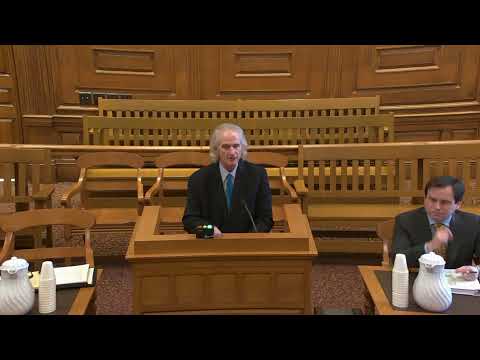
Justice Robert Bridal convened argument in Commonwealth v. Devon Johnson in the Appeals Court, where counsel disputed whether the evidence could establish the specific knowledge required for an accessory‑after conviction.
Suzanne Renaud, attorney for Devon Johnson, told the court the Commonwealth’s theory—Johnson knew of a plan to commit an armed robbery before his co‑defendants entered the victim’s home—was “just a theory of the commonwealth, and it's speculative.” Renaud stressed that the statute requires knowledge of the specific crime and said the record shows the visitors said they were going to “buy weed, not to steal it.” She urged the panel that short, reactive acts captured on video—Johnson opening car doors after seeing friends sprinting—did not prove the requisite prior knowledge.
Marina Moriarty, arguing for the Commonwealth, countered that the defendant need not know every element of the substantive offense and that a “reasonable jury could find” knowledge from the sequence of events. Moriarty pointed to the video timeline, visible weapons, duffel bags, blood on a co‑defendant, and testimony that Johnson had arranged to sell marijuana to hotel customers that night. She said those facts, taken in the Commonwealth’s favor, supported an inference that Johnson knew the crime “went bad.”
Defense and prosecution also debated what assistance or concealment Johnson provided at a later motel encounter. Renaud argued the most material concealment at the motel was of one co‑defendant’s blood, not of stolen property; she said that without proof that the co‑defendant was a joint venturer in the alleged armed robbery, there was no proof Johnson knew what he was allegedly assisting. Moriarty responded that Johnson’s post‑incident acts—helping co‑defendants, paying for travel, and statements the Commonwealth characterizes as consciousness of guilt—supported accessory liability.
Counsel cited older treatises and case law in support of opposing readings of the accessory statutes and common‑law doctrine. Renaud invoked the long line of accessory authority (including the treatise Perkins and older cases) to argue limits on accessory liability when the principal cannot be convicted; Moriarty relied on Modern SJC precedent she said preserves accessory liability where the record supports proof of the underlying crime even if a co‑defendant cannot be tried or convicted.
The panel questioned counsel on timing—whether knowledge must exist before the assistance and how long a jury may infer planning from observed conduct—and on how the video and testimonial record should be read in light most favorable to the verdict. No decision was announced at argument.
The appeal raises a narrow legal question for the panel: whether the trial evidence, read in the light most favorable to the Commonwealth, was sufficient to let a jury find Johnson had the specific knowledge of an armed robbery required for accessory‑after conviction.