Get Full Government Meeting Transcripts, Videos, & Alerts Forever!
Get email alerts on the Economic Development topic
No spam. Unsubscribe anytime.
Consultants solicit College Place input for economic development strategy
Summary
College Place commissioners and staff met Jan. 6, 2025, to provide local input for a comprehensive economic development strategy (SEDS) and to feed a SWOT analysis consultants will use to draft industry- and site-level recommendations.
College Place commissioners and staff met Jan. 6, 2025, to provide local input for a comprehensive economic development strategy (SEDS) and to feed a SWOT analysis consultants will use to draft industry- and site-level recommendations.
Consultant SEDS lead Mr. Saldanha opened the facilitated session and said the team was collecting interview and survey input to inform the SEDS and would follow up with on-site visits and one-on-one interviews. "This is a ... facilitated discussion," Saldanha said, describing the session as part of the strategy’s information gathering.
Why it matters: The SEDS will guide marketing, target-industry outreach and infrastructure priorities the city and county use to recruit retailers, restaurants, light industrial employers and lodging — sectors residents and business leaders said are underdeveloped in College Place.
Commissioners, business owners and staff identified several locally viewed assets: vacant infill parcels that could be repurposed for housing or commercial uses; a relatively affordable housing stock compared with nearby markets; parks and outdoor recreation amenities; multiple educational institutions in a small community; and Martin Airfield adjacent to the city.
Speakers urged the SEDS to use those assets to market College Place’s catchment area to retailers and restaurant chains. The consultant team noted its market outreach will use drive‑time rings (10, 30 and 45 minutes) and ESRI Business Analyst data to show consumer spending and daytime population.
Participants also laid out threats and barriers. Several commenters said county urban growth area (UGA) boundaries and the county’s previous approach to expansion constrained infill and industrial diversification. Developers and business advocates raised timeliness of planning reviews and regulations as a deterrent to investment. A commissioner said school capacity is nearing limits and could constrain further residential growth unless the district expands.
Other recurring barriers included parking shortages in the commercial core, a shortage of hotel rooms and fine‑dining options that keep visitor spending in neighboring Walla Walla, limited incubator and conversion-ready industrial space, and fragmented ownership or control of key roads and irrigation infrastructure (several sites on Myra Road/Meyer Road lie outside city control). Participants recommended exploring incubator space, food-court/food-truck aggregation and more hotel‑linked dining as near‑term tactics to grow local food service and retain visitor spending.
Staff and stakeholders provided numeric details the SEDS will incorporate. Participants discussed ESRI consumer‑demand figures and median‑home‑value forecasts used in city marketing: at half‑hour drive time the consultant’s data show median household income rising from about $69,000 (2024) toward an estimated $80,000 (2029); Meadowbrook 10‑minute median home value shown at about $409,000 in 2024 rising to $542,000 in 2029. Commissioners and a lender at the meeting called the projected home‑value increases a potential constraint on workforce housing.
City staff described actions already under way to address business friendliness. The Community Development Director said the city recently added a senior planner and additional inspectors to improve permitting timeliness and is implementing an online permitting portal. Staff also said the city has a Department of Health grant to study consolidation of smaller irrigation districts on the north side of College Place.
Consultants outlined next steps: on‑site visits and stakeholder interviews to be completed the week following the meeting, and a first draft of the economic conditions and target‑industry analysis scheduled for distribution by Jan. 27, 2025. The consultants said the SEDS team will present the SWOT results at the commission’s next meeting.
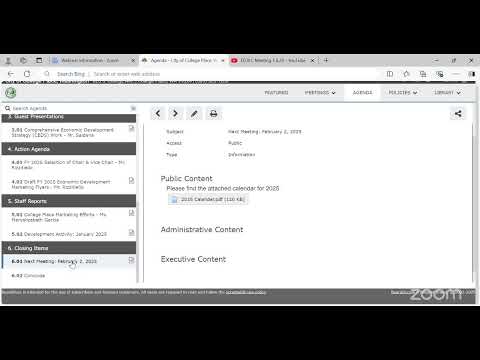
Ending: The commission’s next meeting is scheduled for Feb. 2, 2025; consultants and staff said they will present the draft analysis and preliminary target‑industry recommendations at that meeting.