Get Full Government Meeting Transcripts, Videos, & Alerts Forever!
Get email alerts on the Economic Development topic
No spam. Unsubscribe anytime.
Port Washington council hears first public briefing on proposed north-side data center
Summary
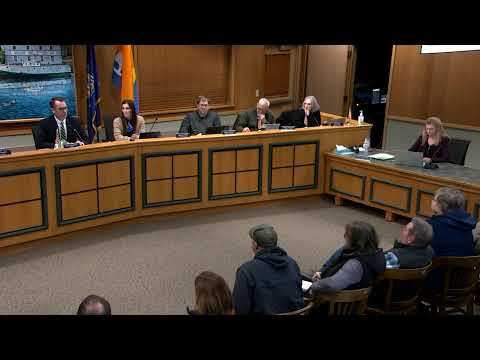
Developers from Cloverleaf Infrastructure and city legal counsel briefed the Port Washington Common Council on Jan. 27 about an early-stage proposal to develop a data center campus on the city’s north side.
PORT WASHINGTON, Wis. — Developers from Cloverleaf Infrastructure and the city’s special counsel briefed the Port Washington Common Council during a Jan. 27 work session on an early-stage proposal to explore locating a data center campus on the city’s north side.
The briefing, led by Aaron Bilyeu, chief development officer for Cloverleaf Infrastructure, described the company’s “power-first” site-selection model and explained basic data center components, utility requirements and common community concerns. Chris Smith, special counsel assisting the city, said Cloverleaf has agreed to reimburse the city for outside costs related to exploring the project and that council members will consider a formal agreement to that effect.
Why it matters: Council members and the mayor framed the discussion as the start of a long process that could rebalance the city’s tax base, upgrade local infrastructure and create construction and operations jobs — while also raising questions about water use, noise, traffic, fire protection and municipal authority over land-use and annexation.
Bilyeu said Cloverleaf finds and secures electrical capacity first, then assembles the real estate to serve large electricity customers. He described typical data centers as buildings filled with servers, complex mechanical and electrical systems, on-site substations and substantial fiber connections. "Data centers really power AI and Cloud growth," Bilyeu said during the presentation.
On utilities and rates, Cloverleaf's team told council members that the additional generation and transmission needed to serve a large data center would be paid for by the data center owner and recovered through a separate tariff, and therefore would not raise rates for existing We Energies customers. The presentation said long-term upgrades that utilities install to serve the site can have the secondary effect of strengthening the broader grid.
On water use, Bilyeu said the company is studying lake-water cooling options and has discussed the idea with the Wisconsin Department of Natural Resources; he described closed-loop systems that return slightly warmed water to the lake and said water consumption for modern data centers has dropped significantly. "Microsoft has committed to have no water consumption going forward for any of their AI data centers," he said as an example of changing industry practice.
Council members asked about noise, lighting and traffic. Bilyeu said modern siting and mechanical design, plus distance and sound walls when necessary, reduce noise, and that data centers typically generate less ongoing truck traffic than industrial uses because heavy truck movements occur mainly during construction and periodic server refresh cycles (roughly every three to five years). On lighting, he said projects typically use downward-directed fixtures and comply with local limits on off-site light spill.
Several council members pressed for quantifiable details. Bilyeu provided industry reference points: construction workforce ranges cited as "12 to 1,500" workers depending on project scale, and long‑term operations typically produce about "50 to a100" full‑time jobs per data center building; he also described electrical sizing in megawatts (examples included 48 MW standard buildings, a 150 MW campus at Meta, and single buildings up to 350 MW in the current AI-driven market). He emphasized that final scale depends on the amount and timing of power We Energies can deliver.
Chris Smith, special counsel to the city, told the council the next steps are procedural and protective: the city will seek contractual protections so taxpayers do not bear exploration costs, may consider a tax-increment or similar financing structure so public costs are borne by project beneficiaries, and will negotiate any necessary annexation agreements with the Town of Port Washington if the project site crosses municipal boundaries. "Protecting taxpayers from any negative impact will be a common theme throughout this process," Smith said.
Council members directed staff to compile questions and studies for an FAQ and to analyze impacts on city infrastructure, staffing, environment and public safety. City staff said they will publish the presentation and an FAQ collection and invited residents to submit questions; the administration said it will post materials on the city’s Facebook page and provided an email contact for economic development inquiries (economicdevelopment@portwashingtonwisconsin.gov).
The session closed without a decision to pursue or approve the project; council members repeatedly described the meeting as an informational "step 1" and agreed that much remains to be determined, including exact site boundaries, utility deliverability and the identity of any end user. The council took one formal vote at the end of the work session to adjourn; the motion passed.
What’s next: Officials said more studies, utility analyses and public updates will follow if the city and Cloverleaf decide to continue exploring the site. Any zoning, annexation, development agreements or tax arrangements would return to the council for public hearings and votes.
Community members and councilors expressed both optimism about economic diversification and concern about environmental and service impacts; the city said it will collect council and public questions for further study and that subsequent steps will include neighborhood outreach and technical studies by utilities and environmental regulators.