Get Full Government Meeting Transcripts, Videos, & Alerts Forever!
Get email alerts on the Vote Centers topic
No spam. Unsubscribe anytime.
Vote Center Study Committee recommends Monroe County adopt vote centers, urges more early-voting sites
Summary
The Monroe County Election Board’s Vote Center Study Committee reported it recommends converting the county’s 29 super‑precinct sites to a vote center model, while urging expanded early‑voting availability and further cost analysis before final board action.
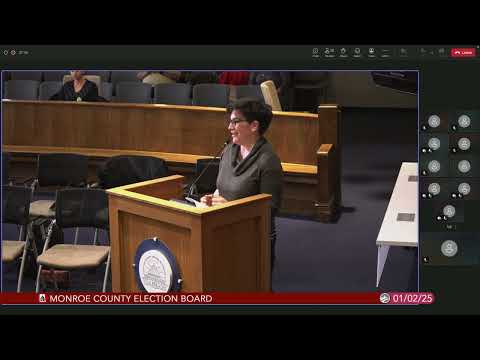
Elana Stonebraker, head of the Monroe County Election Board Vote Center Committee, told the board the committee recommends adopting vote centers and converting the county’s current 29 super‑precinct locations to a vote center model.
The committee’s report summarized a year of work, including listening sessions in Ellettsville, Unionville and on the Indiana University campus, meetings with the Monroe County NAACP and input from the Stone Belt Board of Directors and IU PACE students. The committee heard consistent public support for convenience and accessibility — particularly campus‑adjacent and transit‑served sites — and said voters generally viewed vote centers as less confusing than the current precinct model.
“Vote centers have potential benefits for Monroe County voters and should be adopted,” Stonebraker said. She said the committee plans a final written report and public comment period before the board votes on any formal change.
Why it matters: switching to vote centers changes logistics, equipment needs and voter outreach. Committee members urged the board to weigh up‑front costs against potential long‑term gains in convenience and election‑day efficiency.
Committee findings and recommendations
• Convert the county’s existing 29 super‑precinct locations to vote centers, preserving familiar sites where possible.
• Increase early‑voting locations in the 10 days before an election — the committee discussed three geographic hubs (north, middle, south) as a likely minimum for expanded early voting and suggested specific campus and community sites, including the IU Memorial Union, the IU Center for Representative Government and the Monroe County Public Library Southwest branch, as potential locations.
• Maintain or supplement current equipment: the county already owns approximately 130 secure e‑poll books; vote centers would require on‑site ballot printers (the committee called them “print devices” or printers‑on‑demand) and label printers or “auto ballot kits.” The committee is still finalizing one‑time and recurring cost estimates.
Technical, legal and operational concerns
The committee discussed security and operations: vote center machines are not connected to the internet, the committee recommended diagrams and a compliance checklist be prepared to meet statutory or administrative requirements, and staff noted each vote‑center site must have the ability to print ballots for any precinct in the county.
Kylie, a county elections staff member, said counties that use vote centers typically equip each location with a minimum of two print devices and scale up for larger sites, and that the model is operationally similar to the county’s early‑voting setup.
Committee members and board discussion
William Ellis, a vote center committee member, asked that the committee include a cost comparison showing current per‑election operating costs versus estimated operating costs under a vote‑center model so budget decision‑makers can evaluate savings or added expense. “We need a cost estimate not of just the transition cost, but what it costs to run election now versus what it’s gonna cost to run an election with vote centers,” Ellis said.
Ralph Shaw, also a committee member, and other participants said interviews with other Indiana counties and internal reviews did not show a consistent turnout increase or decrease tied solely to vote‑center adoption, but they said vote centers can reduce the number of voters who cast provisional ballots at the wrong site. “When we talked with and interviewed people from other counties, they generally said that it did not change the number of people who voted,” Shaw said, noting county experience shows some voters still go to the wrong location under either model.
Some board members raised operational concerns about staffing, wait times and equipment needs if every precinct became a vote center. One board member warned that converting every existing precinct to a full vote center could create uneven use — some centers may be underused while others get overwhelmed — and urged careful planning on staff and budget impacts.
Next steps and outstanding items
The committee said it will finish a written report with detailed cost estimates (including staff and equipment), diagrams for the compliance checklist, and site‑level accessibility assessments. The committee identified a range of implementation scenarios discussed in other counties: a mandatory minimum of about 12 vote centers at launch and an eventual average of about 22 centers after several years of adjustments, but final numbers will be decided after public comment and detailed cost analysis.
The board received the update; no formal change to voting policy was adopted at the meeting. The committee will provide its final report and there will be an opportunity for public comment before any formal board action.