Get Full Government Meeting Transcripts, Videos, & Alerts Forever!
Get email alerts on the Budget Finance topic
No spam. Unsubscribe anytime.
Bonner County ambulance district outlines multi-year shortfall, commissioners vote not to seek temporary levy
Summary
Bonner County Ambulance District officials presented December financials showing reduced reserves after capital transfers and one-time funding; commissioners voted to approve a claims batch and to not place a temporary levy override on the ballot now.
Bonner County Ambulance District officials told residents on the district—oard nd the public that the service faces a multi-year budget shortfall driven largely by capital transfers and one-time funds rather than ongoing revenue shortfalls, and the Board of County Commissioners voted not to place a temporary levy override on the May ballot.
The ambulance district projected roughly $713,000 in available cash at the end of the fiscal year based on December-computed figures and a straight-line 3% annual expense increase. Chief Lindsey said the district "was founded in 2005 as an ambulance district under Idaho statute 31,3908" and stressed the need to separate district business from county business while building reserves.
The presentation showed three items that materially changed the cash picture: (1) $2.3 million of operating funds were used in prior years to support construction of a county multiuse building that included EMS space, (2) about $4.5 million of one-time federal and tribal transfers (ARPA and tribal consistency funds) arrived across three years and were designated for capital or nonrecurring spending, and (3) foregone levy capacity accumulated over yearsapproximately $573,228 from 2014—orwardthat the district can recover but had not been captured annually. Eric Wright, who prepared the exported accounting spreadsheets shown at the meeting, said that when the building expense is removed from the three-year view, the district ppears in better financial shape but that the building transfers drew down reserves.
Chief Lindsey and county staff described personnel attrition this winter as a near-term relief to cash flow: three recent separations will save roughly $250,000 for the remainder of the fiscal year and about $355,000 on a full-year basis if positions remain unfilled. Lindsey cautioned, however, that personnel represent the majority of the budget and that relying on attrition alone is not a long-term strategy. He said the district is looking to expand its part-time staffing pool to reduce overtime costs but is constrained by county human-resources limits and PERSI retirement rules that force temporary breaks for employees who reach four months and 29 days of service.
On possible emergency borrowing, Lindsey said the district used a temporary note (TAN) earlier this fiscal year and clarified a fee point: "it was $35,100 once," not a repeated withdrawal fee. He estimated the district might need two to three additional TAN draws over the next few years under the baseline forecast unless further attrition or other changes reduce operating costs.
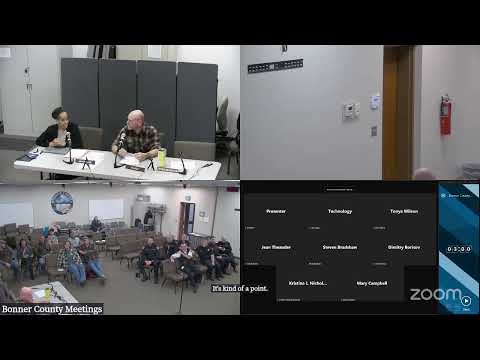
Commissioners and staff discussed whether to place a temporary two-year, $1 million-per-year levy override on the May ballot. Lindsey said he would "only request a temporary two-year override. No no permanent levy at all." After public comment and discussion, the commissioners voted to decline seeking a temporary override now; the ambulance district nd county said they will continue monthly monitoring and revisit options before any ballot deadline.
Formal actions recorded at the meeting included an approved claims batch and the board vote on the levy. The ambulance district claims batch 14 for fiscal year 2025, totaling $13,071.17, was moved, seconded and approved by roll call. Later, the board passed a motion recording that they would not seek a temporary levy override at this time.
Why it matters: The district provides 24/7 advanced life support to Bonner County and depends heavily on local tax revenue and a relatively small billing recovery rate. With personnel making up roughly 80—ent of the budget, the district must balance staffing needs against the county—iscal constraints, avoid repeated short-term levies and rebuild reserves to cover seasonal cash-flow gaps.
What to watch next: county staff said they will continue producing weekly cash-position updates to the commissioners and the district and will reconvene on operational and rate changes after the January tax distribution to determine whether further actionsincluding a levy or additional TAN borrowingare required.