Get Full Government Meeting Transcripts, Videos, & Alerts Forever!
Get email alerts on the Redistricting topic
No spam. Unsubscribe anytime.
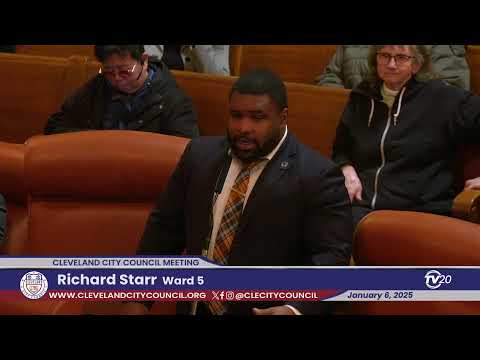
Cleveland council adopts new 15-ward map amid widespread public opposition
Summary
Cleveland City Council voted to adopt Ordinance 1 2025, reducing the council from 17 to 15 wards and approving new ward boundaries after extensive public comment and heated debate over community input and neighborhood splits.
Cleveland City Council voted to adopt Ordinance 1 2025, approving new ward boundaries that reduce the number of wards from 17 to 15. The motion to suspend the rules and place the ordinance on final passage passed on a motion by Councilmember Bishop, seconded by Councilmember Polencik; the final recorded vote on passage was 14 yeas and 2 nays.
The change to ward boundaries drew more than a dozen public comments and several hours of discussion during the council meeting. Residents and community groups urged the council to delay action, to allow more public input and to preserve neighborhood integrity. "These lines are our tickets to representation," said Diabdar Issa, a Ward 11 resident who said the proposed map would split neighborhoods and dilute communities of interest. "Please take this into consideration. It's so much more important than the vote in November," Issa said.
The League of Women Voters of Greater Cleveland urged the council not to rush the process. "Now is the time for community input, public meetings, and revisions based on public input," said Nadia Zayim, co-president of the League of Women Voters of Greater Cleveland. Several other Ward 11 speakers described precinct splits that they said would divide historic voting blocks; one speaker asked council to "pause this vote" for further discussion.
Council President Blaine A. Griffin defended the process and said consultants were brought in and multiple map versions were considered. "We gave our best effort, we did the best that we could, and we believe that we have a process that was transparent, that was fair," Griffin said, acknowledging that the city lost two wards on the East Side because of population decline. He said consultants and council members made adjustments after community feedback.
Several council members spoke in favor of the map or praised the process of public meetings and consultant involvement. Councilmember McCormack said the council sought to "run a process" that balanced competing priorities and called the result an imperfect but necessary response to population changes. Other council members — including one who explained her no vote during debate — said the ordinance moved too quickly, in part because it was passed under suspension of the rules after a single reading.
Public commenters cited neighborhood names and impacts repeatedly: Slavic Village, Edgewater, Detroit Shoreway, Clifton-Baltic (West Boulevard), and multiple precincts in Ward 11. Several speakers said the maps would divide established community development corporation service areas and make coordinated neighborhood advocacy more difficult. Speakers also warned of perceived incumbent protection and requested more weeks or months of outreach rather than the short public sessions held in October.
Ordinance 1 2025 amends sections of the codified ordinances relating to boundaries and wards. During debate, council members referenced the city charter's reading requirements and said the measure was passed under an emergency suspension of the rules with one reading rather than the typical multi-reading process with committee consideration.
Votes at the meeting show mixed council support: the motion to suspend the rules was reported as passing (15–1 on the suspension vote at an earlier roll-call); the final passage roll-call returned 14 yeas and 2 nays. Councilmember Casey is recorded as voting no. One councilwoman expressed a public explanation for voting no and said the process denied residents adequate opportunity for revision; her name was not tied directly to that explanatory remarks in the transcript segment that recorded her comments.
The ordinance will change neighborhood representation ahead of the next election cycle. Council members and speakers said demographic change and census undercounts drove the need to shrink the number of wards, but several residents and community organizations told council that the map as adopted will keep some neighborhoods divided and urged future charter or procedural changes to remove elected officials from the final line-drawing process.
The council also received requests and background materials from community groups and consultants, including a handout from the League of Women Voters offering an alternative map and analysis of Hispanic opportunity districts. Council President Griffin said maps going back to the 1960s were reviewed as part of the work and urged residents to consult the posted maps on the council website.
The council adjourned after completing the agenda; the record shows the next regular meeting scheduled for Jan. 13, 2025.