Get Full Government Meeting Transcripts, Videos, & Alerts Forever!
Get email alerts on the School Finance topic
No spam. Unsubscribe anytime.
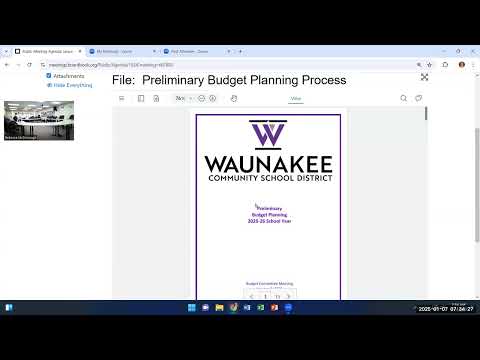
Waunakee budget committee sets goal of net-zero in operating fund, flags special-education and benefits cost risks
Summary
The Waunakee Community School District budget committee on Jan. 7 directed administrators to pursue a plan to end the current fiscal year with a net-zero Fund 10 balance after staff reported a preliminary 2025–26 deficit and flagged a special-education reimbursement shortfall that could widen district budget pressures.
The Waunakee Community School District budget committee on Jan. 7 directed district administrators to pursue a plan to end the current fiscal year with a net-zero balance in Fund 10, after staff outlined a preliminary 2025–26 budget showing a modest deficit and larger structural risks.
District finance staff said the district’s current 2025–26 planning shows a “deficit of just over a $140,000,” and identified five highlighted budget issues that together total $1,175,400 and will need to be addressed in coming months. The committee voted to set an end-of-year Fund 10 goal of zero and authorized administrators to reallocate expenditures across accounting funds and identify mid‑year savings to meet that target; the motion passed on a voice vote (all in favor).
The nut graf: the committee framed the vote as a direction to administration to use the district’s unique accounting options — including reallocating referendum-eligible and other expenses into Fund 49 where legally allowable — and to return to the board with concrete mid‑year and 2025–26 strategies rather than wait until late winter or spring.
Staff summarized the revenue and expenditure assumptions guiding the preliminary plan. Revenue assumptions include a $325-per-student state revenue figure, a 5‑year average enrollment (projected growth of 16 students), a 32% estimate for state special-education categorical aid used in current planning, $100,000 lower interest earnings, and continued inclusion of Act 12 personal property tax revenues and the November 2024 operational referendum. On the expenditure side staff used a 4.6% CPI estimate, full funding for the district compensation system, a 5% increase for health insurance and utilities/transportation, a $70,000 increase to district property insurance, and the added operating costs for the new middle school planned to open in September 2026.
Staff and board members repeatedly flagged special-education categorical aid and post-employment benefit costs as the largest medium-term risks. Administrators said a change in the statewide reimbursement calculation for special education has created an immediate pressure for the current fiscal year (see below), and that while the most recent actuarial study showed the post-employment liability declined materially, the district can no longer draw down pre-funded amounts to cover current-year obligations after 2024–25 without a plan.
Options presented to the committee included: a reduction of roughly 2 full-time-equivalent positions in 2025–26 (one of several scenarios that would close the ~$140,000 gap), reallocation of referendum-eligible or other expenses into Fund 49 where legally allowed, targeted mid‑year spending freezes (administrators noted a precedent for freezing purchase orders after March 1), reassessing building and department carryover practices, redirecting discretionary grant allocations (for example CTE grant funds that the high school currently retains), or drawing Fund 10 fund balance. Administrators told the committee they prefer a combination approach rather than a single stopgap.
Special-education aid shortfall in current year
Administrators told the committee the Department of Public Instruction (DPI) is currently estimating state special-education categorical aid will fund roughly 29%–30% of districts’ claims for 2024–25, below the 33.3% figure many districts expected after passage of the state budget. The district estimates that shortfall equates to a current-year gap of roughly $350,000 to $450,000 for Waunakee.
Administrators described two broad responses: accept an end‑of‑year Fund 10 reduction to absorb the shortfall and advocate at the state level for supplemental funding, or direct the administration to develop a mid‑year budget reduction package (they cited $300,000–$450,000 as the general target range) to avoid drawing Fund 10 down. The committee asked administration to prepare options that combine reallocations (including possible Fund 49 uses), temporary freezes, and program changes for board consideration.
Open enrollment and class-section impacts tied to budget strategy
Staff also tied open-enrollment capacity decisions to the budget conversation. Because board policy allows open-enrollment only when class sizes are below the board’s optimum, proposed changes in class sections for kindergarten through sixth grade would directly change the number of open-enrollment seats the district will approve at the upcoming full-board meeting next Monday. Staff presented a scenario that reduces some K–6 grades from 15 to 14 sections in specific schools (for example, a change in 1st and 2nd grade sections across elementary buildings and a reduction in 6th grade sections), and said that, if not resolved through attrition and retirements, reductions could trigger nonrenewal timelines in April–May for affected positions.
Administrators emphasized that the board must finalize open-enrollment capacity in January (state law: once the board approves open enrollment in January, the decision is final for that year), and asked the committee whether it wants staff to proceed with the 14‑section scenario or plan for 15 sections and larger open-enrollment capacity. Administrators said they will meet with principals and Superintendent Dr. Brown before Monday’s full-board packet is issued and will include her recommendation.
What the committee decided
After discussion, a member moved to set the Fund 10 end-of-year goal at net zero and to authorize administrators to begin reallocating expenditures and developing savings strategies; another member seconded. The motion passed on a voice vote (all in favor). Administrators said they will return with detailed options and likely board-ready motions in the coming weeks, and that some of the items brought forward may be unpopular because they unwind long-standing practices such as department carryover balances and discretionary allocations.
Ending
Administrators told the committee they plan to meet with the administrative cabinet and principals immediately, to prepare a recommended package for the board packet next Monday and to continue to monitor the state budget process for special-education aid changes. The committee’s motion on a net-zero target gives administrators direction to prepare reallocations and mid‑year savings if necessary.