Get Full Government Meeting Transcripts, Videos, & Alerts Forever!
Get email alerts on the Rv Parks Regulation topic
No spam. Unsubscribe anytime.
Temple staff outline proposed RV-park rules, CUP criteria and inspection checks
Summary
City planning staff presented proposed conditional-use permit criteria and Chapter 31 code edits that would set development standards, long-stay documentation and buffering for RV parks; no formal council action was taken at the workshop.
City planning staff briefed council members on proposed amendments to Temple's Unified Development Code and Chapter 31 that would tighten requirements for conditional-use permits (CUPs) for recreational-vehicle (RV) parks and clarify post-approval development standards.
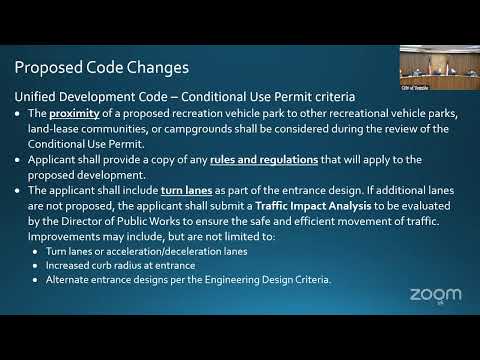
Planning case manager Jason and other staff said the recommendation packages are intended to give the city objective criteria for evaluating RV-park proposals while preserving case-by-case discretion in the CUP process. Jason said the changes would require applicants to submit a rules-and-regulations packet, maps showing proximity to other parks and documentation for long-term occupants, and to demonstrate traffic mitigation where appropriate.
The proposals would not tell park operators what to put in their guest rules, Jason said; instead the city would require that operators submit whatever rules they will enforce (for example: quiet hours, pool restrictions, no illegal drugs) and keep a guest register that can document longer stays. Current code caps occupancy at 180 days, and staff said they are not proposing to permit permanent residency but want to recognize circumstances—employment contracts, military orders, caregiving or property damage repair—where an RV resident could lawfully stay beyond six months if documented in the guest register.
Traffic and access were a central concern. Staff described a requirement that applicants either commit to entrance improvements (acceleration/deceleration or turn lanes) or submit a traffic-impact analysis (TIA) to justify why they are unnecessary. Jason said the city would follow practice used for other developments: if the applicant commits to improvements equivalent to what a TIA would recommend, TxDOT concurrence may make a full TIA unnecessary; otherwise the city can require a TIA and engineering review.
Staff also proposed development standards drawn from Chapter 31: clearer grouping of the guest-register and long-stay rules, minimum internal lighting where necessary, and an average 300-foot buffer between the public right-of-way and the park boundary in some cases to avoid direct visibility from main roads. There was discussion about minimum lot acreage to provide a commercial buffer zone (retail or other uses) between parks and the street.
Health and sanitation standards would remain subject to Bell County Health review for septic systems; if a park connects to the city sewer system, public-works engineering would review capacity and volume. Staff noted many local parks use either hookups at every pad or a central dump station; specific hookup and connection details would be handled at the policy level rather than embedded as code technical specs.
Council members asked whether the proposed placement restrictions (for example, not allowing parks in inner-city lots) had been settled; staff replied that placement is tied to base zoning. Under current zoning, RV parks would be allowed only in agricultural (AG) zoning with a CUP, so any proposal in a non-AG district would require rezoning or different approvals. Staff said Chapter 31 language and the Comprehensive Environmental Permit (CEP) edits will be presented to the planning recommendation body and later to council for action on the UDC.
No formal vote or motion was recorded at the workshop. Staff said they will return with the CEP language and a fuller presentation of the draft UDC changes for council recommendation and possible future council action.
Ending
Staff characterized the package as a way to bring clarity and consistency to RV-park reviews while preserving case-by-case judgment under the CUP process. Council indicated additional interest in a future workshop and staff said they will schedule fuller briefings and return the UDC/CEP language for formal recommendation and subsequent council consideration.