Get Full Government Meeting Transcripts, Videos, & Alerts Forever!
Get email alerts on the Solar Energy Data Center topic
No spam. Unsubscribe anytime.
Developer proposes 4-MW solar field with small data center on Peace Road; concept will require annexation and rezoning
Summary
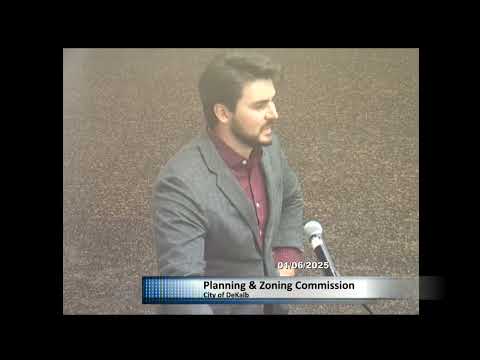
Donato Solar presented a concept plan to the DeKalb City Planning and Zoning Commission on Jan. 6 for a 4-megawatt ground-mounted solar array, an on-site lithium iron phosphate battery system and two small data center buildings on about 30 acres along the west side of Peace Road between Greenwood Acres Drive and Challenger Drive.
Donato Solar presented a concept plan to the DeKalb City Planning and Zoning Commission on Jan. 6 for a 4-megawatt ground-mounted solar array, an on-site battery system and two small data center buildings on about 30 acres along the west side of Peace Road between Greenwood Acres Drive and Challenger Drive.
The concept plan matters to nearby residents because the site is currently outside the city limits and would have to be annexed and rezoned before construction. Dan, a city staff member, told the commission the site is contiguous to the city and that the developer will need to file a petition to annex, a rezoning request (staff said the likely district would be Plan Development Industrial, or PDI) and a more detailed site plan before any construction could begin.
Nick Mahoney, representing Donato Solar, described the proposal as a behind-the-meter project that would deliver up to 4 megawatts to serve the on-site data center load and export excess energy to the ComEd system. Mahoney said the proposal includes a photovoltaic array facing south, two battery containers measuring about 200 by 60 feet, and two modular data center buildings roughly 20 feet tall and about 60 feet long by 20 feet deep. He said the company owns the land and would own and operate the solar array and batteries. "We're kind of at the very preliminary stages of the planning process," Mahoney said.
Why it matters: annexation and rezoning give the city control over setbacks, landscaping and long-term site obligations such as decommissioning and financial assurance. Dan said the city requires a decommissioning plan under the Unified Development Ordinance (UDO) before work can begin; that plan would describe removal and financial assurance at end of life.
Key technical points and public concerns - Battery technology: Mahoney said the battery system would use lithium iron phosphate (LFP) chemistry. He said the batteries are designed and tested to meet applicable fire-code standards and are packaged so that a single-cell failure would not cascade. "All of the battery systems, in order for them to be approved…have to pass that code," he said, referring to standards consistent with the International Fire Code and the city's updated building/fire codes. - Noise and cooling: Mahoney said the modular data centers would be air-cooled rather than water-cooled. "They will not be water cooled…These are small, they're modular, they don't really make much noise at all. They're air cooled," he said. City staff and the developer said typical noise studies are done for inverter and equipment noise and that, on a road with normal traffic, the roadway noise often exceeds inverter noise. - Setbacks and heights: Dan summarized applicable development standards noted in the concept review—staff said a 50-foot setback from the property line for solar arrays is required and that a 100-foot setback to residential areas applies; he said the proposed layout meets those setbacks. The developer said panel frames would sit roughly 18 inches at the low end and about 9 feet at the high end of the slope. Mahoney said the panel arrays would be under the UDO's maximum height for such installations; the data center buildings were described as about 20 feet tall in the concept materials, and staff said final plans must show compliance with the UDO or request any variances. - Site utilities and service: The developer said initial plans include extending sanitary sewer and water for a small restroom and routine maintenance needs. Mahoney said his team has discussed sewer routing with public works and sanitary authorities. - Timeline and utility interconnection: Mahoney estimated on-site installation could be completed in roughly 6–9 months under an accelerated schedule, but he cautioned the utility interconnection and energization by ComEd can take much longer and slow the project. He said projects sometimes sit idle finished but not energized while awaiting utility work. - Decommissioning and ownership: Mahoney said panels are typically rated for about 25 years and batteries for about half that; he said Donato Solar would prepare a decommissioning plan and financial assurance to prevent abandoned equipment at end of life. City staff confirmed the UDO requires such documentation.
Public comment and city feedback Three nearby residents spoke at the meeting: Eric Kristoff (1496 Cambria, Unit 5) raised questions about the data center workload and potential noise and water use; Elizabeth Johnson (1504 Cambria Drive, Unit 6) asked about the battery chemistry and fire-suppression systems; and Dawn Gavin (1480 Cambria, Unit 6) asked about construction timeline and potential impacts to local rodents after site disturbance. Mahoney responded that the data centers are leased, air-cooled, and sparsely staffed for maintenance; that batteries would be LFP and packaged to meet fire-code testing; and that the company uses a seed mix under arrays to reduce soil disturbance and, over time, reduce nuisance wildlife impacts.
No formal action taken The presentation was a concept review only; the commission took no formal vote or action. Dan said that if the applicant proceeds they will need to submit annexation and rezoning petitions and that residents within 250 feet would receive formal public‑hearing notices for any future hearings.
What to expect next If Donato Solar files for annexation and rezoning, the city will schedule public hearings and require detailed engineering, landscaping (staff noted typical frontage landscaping standards and said the commission may expect enhanced buffers on Peace Road), stormwater and utility plans, a decommissioning plan, and any required noise or fire-safety studies. Utility interconnection timelines with ComEd were cited as a likely project pacing constraint.