Get Full Government Meeting Transcripts, Videos, & Alerts Forever!
Get email alerts on the Solar Energy topic
No spam. Unsubscribe anytime.
Donato Solar proposes 4‑MW array, battery storage and small data center on Peace Road in DeKalb City
Summary
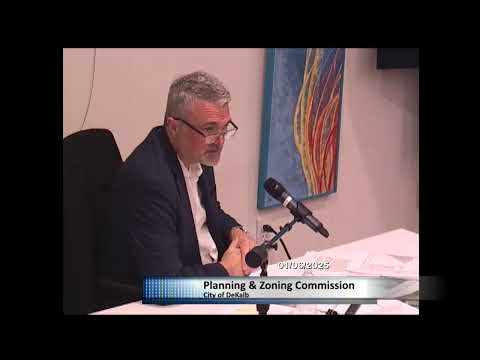
Nick Mahoney, representing Donato Solar, on Monday presented a concept plan to the DeKalb City Planning and Zoning Commission for a 4‑megawatt ground‑mounted solar field, on‑site battery storage and two small data‑center buildings on about 30 acres along Peace Road.
Nick Mahoney, representing Donato Solar, on Monday presented a concept plan to the DeKalb City Planning and Zoning Commission for a 4‑megawatt ground‑mounted solar field, on‑site battery storage and two small data‑center buildings on about 30 acres along the west side of Peace Road between Greenwood Acres Drive and Challenger Drive. The presenter said the site is contiguous to DeKalb City but outside city limits and would require annexation and rezoning.
The plan calls for photovoltaic arrays facing due south, a battery area of roughly 200 by 60 feet and two data‑center buildings Mahoney described as about 20 feet tall and roughly 60 feet long by 20 feet deep. “These are these are small. They’re modular. They don’t really make much noise at all. They’re air cooled,” Mahoney said, describing the data buildings as remotely operated with only routine maintenance visits.
City staff recommended the property’s future land‑use designation as industrial and said the applicant would likely seek rezoning to a Planned Development – Industrial (PDI) district if the project proceeds. “We recommend the comp plan as you see—they’re industrial for the site,” staff told the commission during the meeting. Because the parcel lies outside the city, Mahoney said the applicant expects to file an annexation petition and a rezoning application and then submit a more detailed site plan.
Neighbors at the meeting raised questions about noise, landscaping, batteries and fire suppression. Eric Kristoff, a nearby resident, asked about data‑center cooling and whether tenants would be loud or water‑cooled; Mahoney replied the buildings would be air‑cooled and said the company typically installs a vegetative buffer along roads and residential edges to limit visual and noise impacts. “Data centers are often loud and use a lot of water for cooling,” Kristoff said. Resident Elizabeth Johnson asked, “what kind of batteries would be present in this battery situation,” and Mahoney replied the project would use lithium‑iron‑phosphate (LFP) batteries and that the battery containers and modules are tested to applicable fire‑safety standards.
Mahoney described operational and safety details: the company’s batteries are LFP chemistry, are supplied in modular containers, carry manufacturer warranties and receive regular operations‑and‑maintenance visits several times a year. He said panels are typically rated for about 25 years and batteries for “about half that.” Staff noted that the city’s Unified Development Ordinance (UDO) requires a decommissioning plan for solar projects to ensure removal or remediation at end of life.
Site and design constraints discussed at the meeting included the UDO’s setback standards: a 50‑foot setback for the solar field from property lines and a 100‑foot minimum to residential zones; Mahoney and staff said the concept complies with those figures as drafted. Panel mounting was described as roughly 18 inches at the base to about 9 feet at the top of the slope, with panels tilted at about a 12.5% grade; the solar racking maximum in the UDO is 15 feet, and the applicant expects to be well below that.
Mahoney gave a typical construction timeline of roughly six to nine months for on‑site work on a flat agricultural parcel, but warned the utility interconnection and energization schedule can delay the project: he said utilities sometimes take months to complete their work and projects can sit completed but offline for eight to 12 months waiting for utility action. The applicant expects to tie sanitary and water service to the data‑center buildings and would provide a bathroom; staff confirmed public works and the sanitary district have been consulted about likely connection points.
The commission did not take formal action Monday; the presentation was a concept review and no vote was required. Staff said the next steps would include filing an annexation petition, rezoning submittal and a subsequent public hearing. Staff also said the city will mail public‑hearing notices to property owners within 250 feet when the annexation and rezoning applications are scheduled.
Questions from commissioners focused on project duration, decommissioning assurances and the scale of on‑site operations. Commission members asked that the applicant strengthen landscaping and buffering between the solar field and the residential enclave; Mahoney said the company typically installs additional landscaping beyond the UDO minimum and is open to doing so along Peace Road.
If the applicant proceeds, the commission and city staff said they will expect a detailed site plan that documents final building footprints and heights, the battery container specification and testing documentation, a decommissioning plan and final landscaping, and that the project comply with the city’s adopted building and fire codes before permits are issued.
No formal schedule for a public hearing was set at Monday’s meeting; staff said notices to nearby property owners will be sent when the application is formally filed and scheduled.