Get Full Government Meeting Transcripts, Videos, & Alerts Forever!
Get email alerts on the Water Infrastructure topic
No spam. Unsubscribe anytime.
La Porte Board tables agreement after debate over plastic water main in Fale Road development
Summary
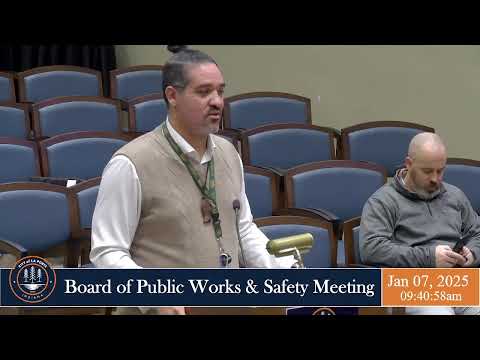
La Porte’s Board of Public Works and Safety on Jan. 7 voted to table a proposed development agreement addressing a private water main installed with plastic pipe on the Fale Road development, after an extended discussion about the city’s construction standards and long‑term liability.
La Porte’s Board of Public Works and Safety on Jan. 7 voted to table a proposed development agreement addressing a private water main installed with plastic pipe on the Fale Road development, after an extended discussion about the city’s construction standards and long‑term liability.
The board’s action came after Tim Werner, the city department head who presented the item, described that a developer had installed an HDPE plastic main past the property line and that the city’s crews do not maintain or repair plastic mains. “We’re a ductile‑iron city,” Werner said. “We would shut it off at the tapping valve in the street, which would kill that whole line, because we just we just don’t work on plastic.”
The discussion centered on two issues: operational limits for La Porte’s water crews and the city’s potential future liability if private plastic mains remained in place and the city later were asked to accept and maintain them. Werner said the city had red‑tagged the original work and that a subsequent company agreed to stay the installation under a written agreement; nevertheless, multiple board members said they were uncomfortable allowing the plastic to remain.
Werner and other staff explained technical reasons for the city’s preference for ductile iron. Werner said crews rely on metallic tracer wires and locating practices that have not proven durable around plastic mains. “Whenever that never works out long term,” he said, “you always have a break in the wire somewhere … that’s an issue for us because we do all our own locating.” He also noted state locate practices that require hand‑digging within four feet of marked utilities.
Board members repeatedly asked whether the city could require removal and replacement with ductile iron. Staff said state building code permits alternative materials on private property, limiting the city’s authority to force replacement on privately owned lines; staff also said the city insisted that ductile iron be used under the public roadway and to the property line so that any pipe under the right‑of‑way met city standards.
After discussion, the board moved to table the development agreement to allow more time for staff to consult with city engineer Nick Otis and to meet face‑to‑face with the developer. “I would like to hold it up if possible,” the mayor said during the discussion. The motion to table carried.
The board did not adopt any new citywide policy at the meeting. Staff said the agreement as drafted is intended to be a protective, hold‑harmless document for the water department and the city in the event of a future break on the privately owned, plastic line. City staff also noted they will revisit how the city communicates construction standards to developers and consider whether additional regulatory or fee approaches are legally available.
Next steps: the item will return to the board after staff follow up with the city engineer and developer; the board asked for additional clarity about the agreement’s legal effect and whether financial or permit incentives could be used to encourage ductile‑iron construction on private developments.