Get Full Government Meeting Transcripts, Videos, & Alerts Forever!
Get email alerts on the County Budget Overview topic
No spam. Unsubscribe anytime.
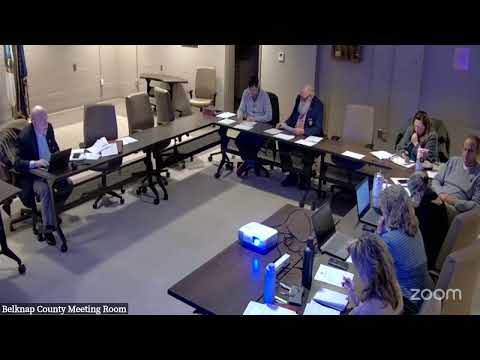
Belknap County budget review: 11.9% initial tax increase driven by personnel costs; committee debates cuts and line-item changes
Summary
Finance staff told the Belknap County Budget Review Subcommittee the starting point for the draft budget is an 11.9% proposed tax increase driven largely by wage and benefit costs; members pushed for cuts to several line items and asked for more data on contracts and shared services.
Belknap County finance staff presented the subcommittee with an initial budget that starts from an 11.9% proposed tax increase and shows county expenses rising about 5.3%, with personnel costs accounting for the majority of the growth.
During the meeting, a finance presenter summarized the budget drivers: wage and benefit increases, contractual obligations with four unions and a cost-of-living adjustment tied to the Consumer Price Index. The presenter said the CPI-based increase is 3.4% effective April 1 and that merit/step increases of about 3.6% are applied on employee anniversary dates when eligible. "The increase is 3.4%," the presenter said when explaining the CPI adjustment.
Finance staff estimated that wages and benefits make up roughly 54% of the county's roughly $38 million budget and that personnel costs represent the lion's share of the year-over-year change. The presenter told members the county's benefit plan now offers two health options — a $1,000-deductible plan and a $3,000-deductible plan — and that the plans changed in the most recent procurement: the $3,000 plan increased by about 14% while the $1,000 plan rose by roughly 5%, reducing the savings for employees who choose the higher-deductible option. Staff described the opt-out incentive payments for employees who decline county coverage; these vary by bargaining unit and by coverage tier.
Committee members pressed finance staff on places to find cuts. A member who serves on the State Budget Committee said the state has been tasked with an approximate 8% reduction at the state level and urged county departments to identify savings now, warning that higher budgets will ultimately impact taxpayers if state reductions cascade to municipalities.
Staff discussed line-by-line adjustments and several agreed changes or holds: - Delegation meeting fees were recommended at $3,000 by commissioners; subcommittee members proposed and agreed to reduce that to $1,500. - The committee discussed lowering the employee-recognition/ longevity-gift allocation; one member recommended cutting a proposal of $45,100 down to $2,000 and the subcommittee agreed to reduce it substantially. - The committee debated membership dues and training: they indicated keeping the New Hampshire Association of Counties membership and removing the national association fee for now, while acknowledging some county functions (corrections academies, corrections certification) require certain memberships. - Office supplies were discussed and the subcommittee agreed to reduce the line from $1,000 to $900.
On auditing and accounting, staff said a financial audit is budgeted at about $32,400 and that the GASB 75 actuarial work (required for other post-employment benefits reporting) will add an additional amount (presenter cited approximately $2,490), with a combined auditing-services estimate stated in the meeting as about $34,890. Staff emphasized the county has had clean audits in recent years and recommended maintaining an outside audit to preserve public confidence.
Insurance and risk costs drew attention: property-liability costs were cited as up roughly 17% in the presenter's figures; the county's insurance pool Primex was discussed as a critical but sometimes costly resource because it offers training and pooled coverage for municipalities.
IT and software costs were a recurring point. The county's contracted IT vendor (Mainstay Technologies) currently provides managed services (presenter cited a multi-year contract and an annual contracted-services figure that was discussed in the meeting); the subcommittee discussed a split of some IT costs with the nursing home (60% nursing-home allocation, 40% general fund). Committee members asked whether Microsoft Teams and the county's existing Microsoft subscription could replace Zoom and SurveyMonkey for meeting streaming and anonymous staff surveys; IT staff indicated this is feasible but that training and verification of anonymous-survey features would be needed before eliminating existing subscriptions.
Facility and grounds items surfaced: maintenance staff reported discovery of a small, county-owned cemetery—about a quarter acre with 61 graves—behind a county property and recommended work to restore headstones, install fencing and signage and then accept a volunteer group's offer to maintain it. Members also discussed parking-lot maintenance, courthouse carpeting and rekeying older courthouse locks, and agreed some deferred maintenance had driven higher repair costs in the current year.
Capital and grants: The capital-improvements discussion included two items noted by staff: (1) a body scanner for the corrections facility to detect contraband, to be offset by money from the state's opioid-trust fund; and (2) a sheriff's project to erect two 8-by-40-foot shipping-container storage units with a roof span between them to provide covered storage for large vehicles and county equipment. Staff said the opioid-trust fund would offset the body-scanner cost (presenter gave the scanner estimate and said it would be paid from that fund).
Debt and cash flow: Finance staff described the county's use of short-term tax-anticipation borrowing to manage cash flow and noted fees for bond counsel and financial advisors (PFM) when borrowings are required. For planning, staff used a conservative interest-rate assumption (the presenter cited an illustrative 5% interest rate for planning purposes) when estimating interest expense for anticipated tax-anticipation notes.
Human-services spending, a large budget line, remains a major driver of overall county spending. Staff said the county is paying the state for home- and community-based services under state rules and that the county budget projection reflects a modest increase in that line tied to state caps and the county's monthly billing estimates.
Meeting members flagged multiple lines for later follow-up and instructed staff to return with more precise bids, contract options and the effects of reallocating shared services (for example, capturing additional nursing-home shares of finance, HR and IT costs where justified). Several members repeatedly urged staff and department heads to identify operational savings because the state's direction toward budget reductions increases local pressure to constrain spending.
No final countywide budget was adopted at this meeting: the session recorded line-item adjustments and consensus directions but left major revenue and levy decisions to future meetings.