Get Full Government Meeting Transcripts, Videos, & Alerts Forever!
Get email alerts on the Opioid Abatement Funding topic
No spam. Unsubscribe anytime.
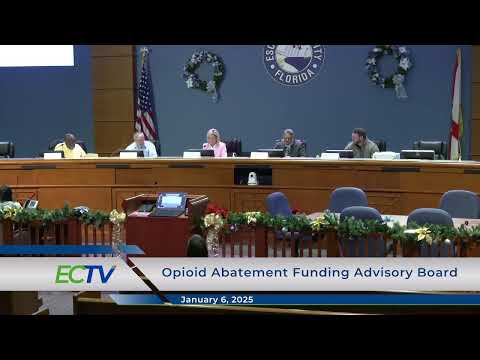
Escambia County advisory board approves use of opioid abatement funds; staff to detail award schedule
Summary
The Escambia County Opioid Abatement Funding Advisory Board voted to approve the use of opioid abatement funds, with the specific dollar amounts referenced in the agenda but not read aloud during the meeting.
The Escambia County Opioid Abatement Funding Advisory Board voted to approve the use of opioid abatement funds, with the specific dollar amounts referenced in the agenda but not read aloud during the meeting.
The approval follows public comment from a local medication-assisted treatment (MAT) provider and an operational update from Community Health Northwest Florida about expanded MAT capacity in Pensacola. Board members discussed notification and application timelines and asked staff to provide more details at the next meeting.
Sean Parker, who identified himself as representing New Season, an MAT provider based in Pensacola, told the board his organization treats 707 patients and urged the board to consider allowing for‑profit treatment providers to compete for abatement funds. “These funds that we're talking about are not philanthropic in nature. And in fact, it's blood money made by unethical and, at times, predatory practicum practices by pharmaceutical and pro doctors,” Parker said. He said New Season currently serves 53% of patients seeking MAT in the county while “those providers” (referring to other providers) serve 47%.
Walter Arrington of Community Health Northwest Florida gave an operational update, saying the organization has opened a third MAT site with provider Ryan Bianco at 348 Herman Ave and has a mobile medical unit with MAT capabilities. “I'm happy to report as of the first, we have now gotten our 3rd MAT site, with provider with Ryan Bianco, located at 348 Herman Ave, up and running,” Arrington said. He told the board the mobile unit’s first deployment will be “on 15th of this month at 31 Murphy Lane.”
Board members asked staff about the board’s authority to change eligibility rules for applicants. An unnamed board member asked whether permitting for‑profit organizations to apply would require action by the County Commission, saying, “I don't think we have the authority to do that, do we?” A staff speaker said they would follow up with the County Commission and provide clarification at a future meeting.
Board members also discussed the schedule for advertising notices of funding. Several board members and commenters said smaller organizations often lack grant-writing capacity and that a short application window can be a barrier; one commenter urged the board to consider a longer application period than the 30 days used previously.
The board agreed to ask staff for clarification on reporting requirements for grantees; a staff speaker said the county will receive reports and that the board should receive copies of those reports. The transcript indicates that Miss Kissel (grant staff) was not present and that staff would bring more detailed schedule and reporting information to the next meeting.
The board moved and seconded a motion “to approve the use of opioid abatement funds, with the amounts listed below.” The motion was approved. The transcript did not record the names of the mover or seconder, the vote tally, nor the specific amounts. The board scheduled its next meeting for March 17 at 10 a.m.
What the board did not decide at the meeting: it did not adopt any change to applicant eligibility rules (for‑profit vs. nonprofit), nor did staff present a finalized advertisement schedule or a complete implementation plan for fiscal year 2025. Board members directed staff to return with more information at the next meeting.