Get Full Government Meeting Transcripts, Videos, & Alerts Forever!
Get email alerts on the Capital Budget topic
No spam. Unsubscribe anytime.
Gurnee staff propose $20.1 million FY2026 capital plan; flags water‑main 'cliff' and long vehicle lead times
Summary
Village staff presented a $20.1 million proposed capital budget for fiscal 2026 that emphasizes transportation resurfacing, water‑main replacement and vehicle/equipment purchases; officials warned a wave of cast‑iron water mains will require planning and funding over coming decades.
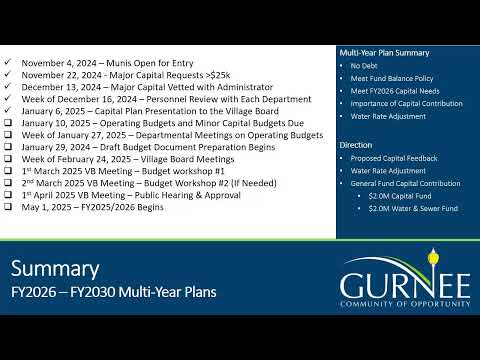
At the Jan. 6 Gurnee Village Board meeting, staff presented a proposed fiscal year 2026 capital plan totaling $20.1 million and a nearly $80 million five‑year capital program that prioritizes transportation resurfacing, water and sewer work and vehicle and equipment replacements.
The proposed FY2026 spending is split roughly as transportation $9.4 million (47%), water and sewer $5.0 million (25%), vehicles and equipment $3.2 million (16%) and buildings and technology about $2.0 million (10%). Staff said the five‑year capital plan is funded primarily on a “pay‑as‑you‑go” basis from the capital improvement fund, home‑rule sales tax (half of which is dedicated to capital), restricted funds such as motor fuel tax and police restricted revenues, general‑fund excess balances and water‑and‑sewer rates. The village also continues to seek grants and has used limited financing for specific projects.
Pat (staff member) and Brian (staff member) briefed trustees on project lists and funding assumptions, stressing the proposal is an initial staff draft and that trustees will consider adjustments through March budget hearings. Brian said the village has applied for roughly $10 million in grants since 2020, received about $1.1 million, was rejected for about $7 million and has $1.7 million pending. He also noted the village still has an outstanding IEPA loan balance of about $3 million.
Staff emphasized construction lead times and material availability as constraints. "It would be great if we could have a $50,000,000 capital plan, but we have some limitations on things," Brian said. He showed estimated vehicle lead times that put squad cars at roughly 10 months and many public‑works trucks at 18–24 months; fire apparatus and ambulances carry the longest waits. Brian added that prepayment or early ordering for some large apparatus has been used in prior years to manage lead‑time risk.
On transportation, the plan includes almost $6.5 million for resurfacing about 7.5 miles of roads and $1.0 million for a reconstruction project (a roughly 0.3‑mile horseshoe area near Glen Flora/Blackburn). The resurfacing program is funded mainly from capital funds and motor fuel tax; staff said motor fuel tax typically covers about one quarter of annual roadway costs and the general fund covers the remainder.
Water and sewer projects total about $5 million for the year, including roughly $3.5 million in water‑main replacement, SCADA upgrades and a sanitary sewer extension to serve three cul‑de‑sacs in Quality Acres that currently lack sanitary sewer. Staff warned of a long‑term concentration of mains built between 1987 and 1997: "When you build it all at the same time, it all kinda falls apart at the same time," Brian said, describing a future multi‑decade spike in replacement needs unless the village smooths the program sooner.
Public‑safety and vehicle requests were detailed by department. The police budget includes five new patrol vehicles, a K‑9 vehicle funded from seizure funds, a UTV replacement, evidence locker upgrades including a dedicated refrigerated unit and a multi‑year Securitas gate/entry upgrade tied to consolidation of dispatch functions. The fire department described plans to place new ambulances and an engine on long lead times and to pursue station interior upgrades and tuckpointing of a 45‑year‑old station.
Public Works outlined several fleet replacements, a new crane truck, a smaller bucket truck, a trailer to replace a borrowed hot‑box and facility improvements including a new fuel island and backup generators for critical facilities. Stormwater work includes a Grove Avenue project to relieve a flow restriction between Grove and Route 41 and funds for floodplain acquisition and general drainage improvements.
On finance, staff showed five‑year fund‑balance forecasts for the general fund and the water and sewer fund. The general‑fund baseline forecast included a $4.0 million transfer to capital at the end of the current year; staff noted no ongoing transfers were assumed in later years and urged conservative budgeting. The water fund forecast assumed a scenario that includes a 6% rate increase to help fund increased annual water‑main work; staff said no formal rate decision was being made at the meeting.
Trustees thanked staff for the detail and asked questions about prepaid apparatus orders, grant opportunities with the congressional office and potential storage for long‑term evidence or homicide vehicles. Staff said the village will hold one‑on‑one budget reviews with trustees in February and the first public budget workshop is scheduled for March 3.
The presentation was for feedback; no formal board action on the capital plan occurred at the Jan. 6 meeting.