Get Full Government Meeting Transcripts, Videos, & Alerts Forever!
Get email alerts on the Building Permit Fees topic
No spam. Unsubscribe anytime.
LaSalle County committee weighs higher building permit fees, flat $250 charge proposed for residential solar
Summary
The Land Use and TIF Committee discussed proposed increases to building permit and plan-review fees, including a recommended $250 flat fee for residential solar and debate over uncapped commercial plan-review charges; no final vote was taken.
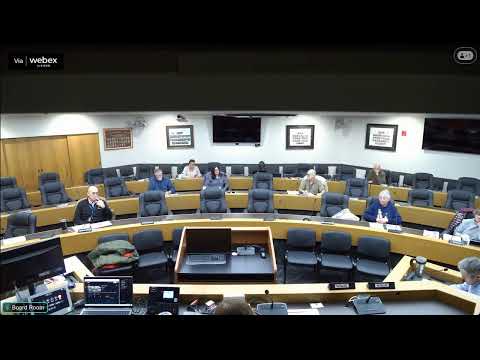
LaSalle County’s Land Use and TIF Committee discussed proposed changes to building permit and plan-review fees at its Jan. 6 meeting, including a staff recommendation to set a flat $250 fee for residential solar permits and a $150 plan-review fee for new single-family homes.
The proposal matters because county staff said fee increases would bring permit revenue more in line with review and inspection costs the county has absorbed since the last increase in 2020. “With the garage the total square feet was 3,493 … with the new $150 plan review and the new fees, [the total] comes out to … about a $430 difference, which is about a 21% increase,” said a staff member who presented the billing examples.
Committee members pressed staff on commercial plan-review charges, which the vendor recommended be charged by the hour without a stated maximum. Committee member Kathy Owens said the lack of an upper limit could create unpredictability for small businesses. “What about the little guy that’s just starting up a little business? It could get out of control,” Owens said. Committee members discussed asking the vendor to propose tiered caps based either on square footage (for example, a lower tier under 10,000 square feet) or by complexity (low, medium, high).
Presenter comments attributed to the vendor contact at a prior meeting — referenced by county staff as Katie Volkovich — indicated that plan-review difficulty, not only square footage, can drive the time required for review. The staff member said they would ask the vendor to propose options that would differentiate small retail or simple shop builds from restaurants or large warehouses that require more fire-suppression and technical review.
On residential solar, staff recommended a flat $250 fee to reduce administrative burden from mailed permits and repeated phone payments. “If we had a flat fee upfront they could just mail that check in with the permit,” the staff member said. The presentation also noted a recent solar fee refund handled administratively: a developer had mailed $5,000 for a project that ended up being 3.6 megawatts, creating a $1,000 overpayment the county returned.
Committee members asked staff to meet again with the vendor to draft a commercial-tier proposal and to compare proposed increases with neighboring counties. Several members volunteered to join a smaller group to review fees with staff and the vendor by web meeting; the committee chair cautioned members not to form a quorum outside a public meeting (a majority would be three members).
No committee vote adopted the proposed fee schedule at the Jan. 6 meeting. Staff said the next steps would be further vendor consultation, a possible committee review, then forwarding the proposed changes to the county finance office and, ultimately, the full county board.
The committee also discussed technical details of the fee model, including preserving a minimum plan-review fee for small projects to cover reinspections, and staff said the county had not raised building-ticket fees since 2020.