Get Full Government Meeting Transcripts, Videos, & Alerts Forever!
Get email alerts on the Us South Korea Alliance topic
No spam. Unsubscribe anytime.
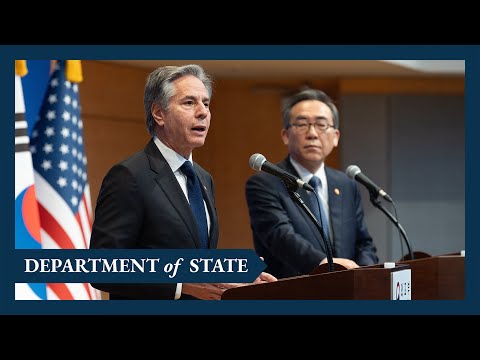
U.S., South Korea reaffirm alliance, condemn North Korean missile launch and pledge closer trilateral ties with Japan
Summary
U.S. Secretary of State Antony Blinken and South Korean Foreign Minister Jo Tae yal used a Seoul meeting to express condolences over recent tragedies, condemn a North Korean missile launch, reaffirm extended deterrence and outline expanded trilateral cooperation with Japan on security, technology and sanctions enforcement.
U.S. Secretary of State Antony Blinken and South Korean Foreign Minister Jo Tae yal met in Seoul and used their joint remarks to reaffirm the strength of the U.S.-South Korea alliance, condemn a North Korean missile launch and describe steps to deepen trilateral cooperation with Japan on security, economic and technological matters.
The ministers opened by offering condolences: Jo Tae yal said, “Korea will always stand with the people of the United States,” and Blinken said the United States had sent teams from the National Transportation Safety Board, the Federal Aviation Administration and Boeing to Korea “to support the investigation” into a recent plane crash. Blinken added, “the United States is here to help in any way that we can.”
The meeting emphasized defense ties and deterrence. Jo said the two governments “reaffirmed that there is no daylight between us in the ROK–U.S. alliance.” Blinken reiterated U.S. commitments to extended deterrence and said the allies had enhanced cooperation “including through the nuclear consultative group.” Both officials condemned the DPRK’s ballistic missile launch that same day and said they would continue coordinated responses, enforcement of U.N. Security Council sanctions and steps to strengthen combined defenses.
The ministers described a push to deepen trilateral cooperation among the United States, South Korea and Japan. Jo said Seoul, Washington and Tokyo have regularized high-level consultations since the Camp David summit, launched sector-specific consultation bodies on security and economic security, and established a trilateral secretariat. Blinken said the three countries are “implementing more than 3 dozen different initiatives in the areas of security, economic relations, and innovation,” and cited joint military exercises, real-time missile data sharing and education partnerships in quantum computing as examples.
Economic and technology ties were also highlighted. Blinken said the United States is now South Korea’s second-largest investor and largest goods export market, and that since 2021 South Korean entities have committed about $140,000,000,000 in U.S. investment, naming the Inflation Reduction Act and the CHIPS and Science Act as drivers of that investment. Both officials discussed cooperation on advanced technology, clean energy and supply-chain resilience.
On wider security issues, Blinken connected the North Korean-Russian military cooperation to broader challenges, saying there is “reason to believe that Moscow intends to share advanced space and satellite technology with Pyongyang” and warning about the implications for global stability. Jo and Blinken said they had discussed mechanisms to monitor and enforce U.N. sanctions on North Korea.
The ministers closed by stressing the long-standing nature of the alliance: Jo said the relationship has endured “for the past 71 years,” and Blinken described the alliance as grounded in shared democratic values and people-to-people ties.
Discussion points that did not result in a formal bilateral action included review of trilateral secretariat progress, assessments of technology- and education-focused initiatives, and continued consultation on sanctions implementation. No formal votes or binding agreements were announced at the press remarks.
The meeting remarks were followed by planned meetings with the National Assembly later the same day, a point Blinken noted when thanking hosts for arranging additional engagements.