Get Full Government Meeting Transcripts, Videos, & Alerts Forever!
Get email alerts on the Municipal Budget topic
No spam. Unsubscribe anytime.
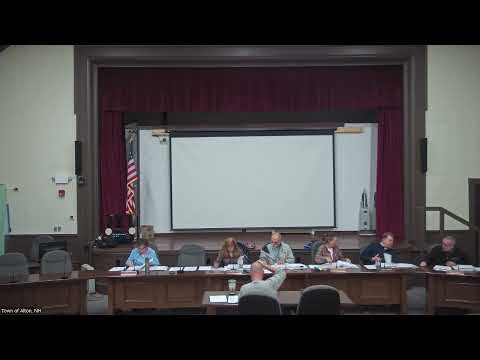
Alton Town budget committee approves multiple operating budgets; flags 2026 solid-waste transportation spike
Summary
The Alton Town Budget Committee approved department operating budgets including benefits, solid waste, household hazardous waste, town clerk and water. Members discussed rising health-plan costs, a planned roll-off truck purchase to avoid a 2026 transport-rate spike, FEMA reimbursements and fund-balance options.
Alton Town Budget Committee members approved a series of department operating budgets and discussed items that could affect taxpayers going into 2026, including a planned roll‑off truck for solid‑waste hauling and how FEMA reimbursements and the town’s fund balance might be used to smooth tax impacts.
Committee members voted, by voice, to adopt the budgets discussed at the meeting: an operating package described in the session as totaling $2,796,798; the Department of Public Works (Solid Waste) budget for $395,521; the Lakes Region Household Hazardous Waste (HHW) program share of $31,300; the Town Clerk/Tax Collector operating budget of $193,066; and the Water Department operating budget of $541,430. Each motion was approved by voice vote with “Aye” recorded and no named oppositions in the transcript. (The meeting record does not include roll‑call vote counts.)
Why it matters: the budgets will affect departmental operations, user fees and the town’s tax rate calculations for next year. Committee members and staff emphasized that some cost pressures are driven by external contracts and state or federal requirements, and several lines are funded by user fees rather than the general tax base.
Most important facts
- Benefits and personnel: Staff reported the town pays 96.5% of employee medical premiums and employees pay 3.5%; dental coverage is split 80/20 (town/employee). To control premium costs the town has moved some employees into higher‑deductible plans rather than increasing employee premium shares. The town offers a 457 supplemental retirement plan with an employer match up to 3%.
- Fire and police retirement contributions: Fire and police retirement lines reflect statutory employer contribution rules. The committee was told the fire department has been transitioning from mostly volunteer to more full‑time staffing since 2021; full‑time fire staffing currently consists of a chief plus six others (seven total). A separate firefighter retiree stipend paid to long‑service volunteers totals about $13,942 annually (roughly $1,300 per retiree by rank on the justification). Police retirement contributions reflect the Group 2 rates; committee discussion indicated 13 officers currently qualify under Group 2 and the line will reflect a 14th position when a full‑time SRO is added.
- Solid waste and transport spike: Public works staff explained the town’s waste‑hauling contract runs through 2026 and the transportation portion of that contract is scheduled to increase sharply — staff estimated a 110% jump in transport costs in 2026. To mitigate that projected spike, the town is exploring buying its own roll‑off truck and shifting to in‑house hauling; earlier part‑time positions would be consolidated into a full‑time role to support that change. The committee approved the Solid Waste operating budget for $395,521 while leaving capital purchase authority (vehicle lease/purchase) for future budget planning because the higher transport rates do not take effect until 2026.
- Household Hazardous Waste (HHW): The committee approved Alton’s share of the multijurisdictional HHW program. The program operates under a cost‑sharing agreement with Wolfeboro and the Lakes Region Household Hazardous Product Facility; Alton’s estimated share is $31,299 (reported as $31,300 in the motion), reflecting roughly a 30% allocation of the total operating request, with Wolfeboro covering about 70%.
- Water Department presentation: The Water Department operating budget was presented as funded by end users (ratepayers) not by general property taxes. Staff said the warrant article will show a $0 tax impact for those who do not receive water service and that revenues collected through billing offset the appropriation. The committee approved the water operating budget of $541,430 (a reported 0.5% budget increase was noted).
- Capital reserves, CIP and fund balance: Staff reviewed capital reserve accounts and the town’s Capital Improvement Plan (CIP). The committee was told the town’s unassigned fund balance is about 14% (reported roughly $4.7 million), below the DRA recommended maximum of 17% but above commonly used operating targets. FEMA reimbursements for storm repairs were discussed: the board has accepted more than $531,000 to date with an additional reimbursement of about $171,000 approved and awaiting payment. Board members said the selectmen are considering using some of those reimbursements and part of the fund balance to partially offset next year’s operating budget in warrant language rather than immediately applying all funds to lower the tax rate.
Discussion, direction and next steps
- Staff and committee members asked for and were given follow‑up items: staff will provide a breakdown of medical plan enrollment (number of family/two‑person/single plans), the finance manager will be invited to the next meeting to explain fund‑balance mechanics and tax‑rate mechanics, and staff agreed to continue exploring roll‑off truck leasing vs. contract options for solid waste ahead of the 2026 contract change.
- The committee set tentative additional meetings in December (first two Wednesdays) to continue budget review and to schedule a joint meeting with school representatives to review the default budget and proposed warrant articles.
Ending
The committee concluded its review of the listed operating budgets and scheduled follow‑up work to provide detail on capital reserves, the HHW contract, the solid‑waste transport plan and how FEMA reimbursements and fund balance options might be presented on warrant language ahead of town deliberative sessions.