Get Full Government Meeting Transcripts, Videos, & Alerts Forever!
Get email alerts on the Decertification Recommendations topic
No spam. Unsubscribe anytime.
POST advisory board recommends revocations for four officers, stays one DUI case with probation terms
Summary
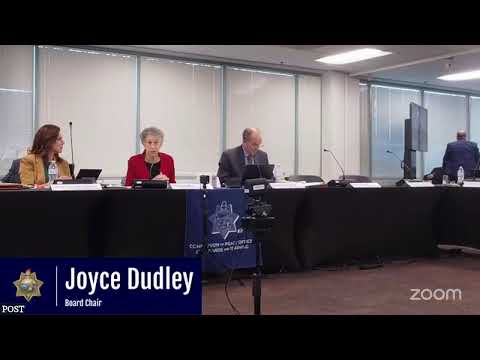
At its Oct. 17, 2024 meeting the Peace Officers Standards Accountability Advisory Board voted on four decertification matters and recommended revocation in each; in one DUI-related matter the board voted to revoke but stay the revocation subject to a probationary settlement with testing and treatment terms.
The Peace Officers Standards Accountability Advisory Board voted Oct. 17, 2024, to recommend that the Commission on Peace Officer Standards and Training (POST) move forward on decertification actions in four cases heard at the meeting. In a separate DUI-driven matter the board recommended revocation with a stayed order and probationary conditions that would include inpatient/outpatient treatment and random biological fluid testing if the officer becomes reemployed.
The board's actions followed presentations by POST law-enforcement consultants and legal staff and public comment. The division summarized its findings in each case and asked the board to find that there was "clear and convincing evidence" that serious misconduct occurred. POST staff presented the legal standards drawn from Penal Code section 13510.8 and related regulations.
Why it matters: POST certification determines whether a person may serve as a sworn peace officer in California. Revocation prevents an officer from obtaining employment as a peace officer in other agencies in the state and is reported to national decertification indices.
What the board recommended (votes at a glance) - James Matuku (then-Riverside Police Department): POST presented an investigation finding repeated dishonesty during internal affairs interrogations after printed “rat buster” flyers were placed in a station locker area. The board voted to recommend revocation. Law-enforcement consultant David Paletta told the board the division had "clear and convincing evidence" that Matuku lied repeatedly to investigators. (Roll call: unanimous among members present)
- Silfredo A. Cano (former Los Angeles County deputy): POST said Cano used his position to initiate a sexual relationship with a person he had arrested for DUI, accessed confidential records to obtain her contact information, ran queries on her record through a partner’s login and attempted to dissuade the arresting deputy from appearing in court. The board voted to recommend revocation. The division described the allegations as abuse of power, "propositioning" under Penal Code 832.7, and dishonesty. (Roll call: unanimous among members present)
- Jaime Bermudez (former Daly City officer): POST presented two DUI convictions (2015 and 2022). The board voted to revoke but to stay the revocation and send the case to the Commission with a proposed stipulated settlement option. POST staff explained prior Commission precedent in which a revocation was stayed and replaced with probationary conditions including treatment, abstinence and random biological-fluid testing for up to five years if the officer becomes reemployed. Bermudez told the board he has completed a 30‑day inpatient program, is in outpatient work and "remained sober since my DUI arrest." The board approved the stayed‑revocation option. (Roll call: unanimous)
- Paul Matichuk (then-Brentwood Police Department): POST presented footage and the internal affairs file showing a kick to a restrained, seated person who began to stand; the division concluded the force was excessive and unreasonable. The board voted to recommend revocation. (Roll call: unanimous; one board member was not present for the vote)
How these recommendations proceed: The board’s recommendation is advisory to the Commission. If the Commission accepts the board’s recommendation, an administrative record is created, and the matter may proceed to an Administrative Procedure Act hearing or to a stipulated settlement the Commission approves. For the Bermudez matter the board explicitly directed staff to pursue the kind of stipulation the Commission has approved in prior DUI-related matters.
Quotes from the meeting - David Paletta, law-enforcement consultant (POST): "The division determined that sergeant Matuku committed the following act of serious misconduct, specifically dishonesty when he repeatedly lied during 2 separate internal affairs . . . interrogations."
- William M. Bowden, law-enforcement consultant (POST): "The evidence demonstrates that Mr. Cano attempted to make good on [his promise to the arrestee] when he approached that deputy and informed him that he had spoken with the victim."
- Jaime Bermudez (former officer): "I'm committed to the changes I've made in my life, and it remained sober since my DUI arrest."
- Paul Matichuk (former officer): "I wanted to deescalate the situation and not take her to jail. . . . If I could take back that moment in a heartbeat, I would."
What the board did not do: These are not final decertification orders. They are advisory recommendations. The board and POST repeatedly reminded speakers and the public that further administrative hearing steps or settlements are required before certificates are finally revoked or reinstated.
Next steps: Each matter will be transmitted to the Commission on POST for its consideration; if the Commission adopts a revocation it will be entered on the national decertification index and published as required by law. If the Commission accepts a stipulation (as the board recommended in the DUI case), POST staff will manage ongoing probation terms and testing if the officer returns to law‑enforcement work.
Ending note: POST staff told the board that revocations that do not go to hearing — defaults, voluntary surrenders and disqualifications under Gov. Code 1029 (felony convictions) — are already occurring in significant numbers, but the board’s role is to judge the clearest and most discussed cases presented in public session.