Get Full Government Meeting Transcripts, Videos, & Alerts Forever!
Get email alerts on the License Reinstatement topic
No spam. Unsubscribe anytime.
Applicant for reinstatement says domestic dispute led to missed notices; board takes petition under submission
Summary
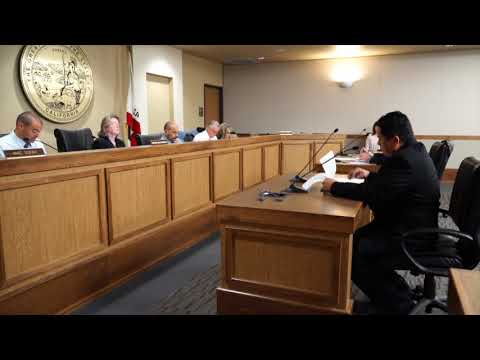
Hector Olivarria asked the Structural Pest Control Board on Oct. 16, 2018, to reinstate revoked operator license OPR 10969, saying marital problems, interrupted mail delivery and relocation prevented him from responding to the board’s audit; the board closed the record and will deliberate in closed session and mail a decision within 100 days
Hector Olivarria asked the Structural Pest Control Board on Oct. 16, 2018, to reinstate operator license OPR 10969, saying that marital problems and a restraining order kept him from receiving mail and documentary notices and that he completed required probationary and anger-management programs; the board closed the record and will deliberate in closed session and mail a written decision within 100 days.
Administrative Law Judge Marilyn Willard opened the petition hearing (agency case 2016-4; OAH case 2018-090583). Deputy Attorney General Tim McDonough introduced Exhibit 1 (the petition packet and related documents), explained that accusation 2016-4 alleged failure to provide proof of continuing education and misrepresentation on a renewal application, and noted a default decision revoking the operator license effective Sept. 15, 2016 and a $1,765 cost-recovery order.
Olivarria, representing himself, told the board he had worked as an operator since 1994, has long experience in pest control and that family and marital disruption led to missed correspondence and the loss of records. He asked the board to consider that the conviction at issue was for a misdemeanor disturbing-the-peace offense and said the underlying facts reflected an argument rather than a physical fight: “So I don't want anybody to ever think that because that was not the case. It was just arguing, I guess, with a loud tone. And that's what it was. So I wasn't physically fighting.”
McDonough and board members reviewed the enforcement file in detail. The deputy attorney general said the accusation alleged the petitioner misrepresented on a September 2013 renewal that he had completed 16 hours of continuing education and later failed to produce verifiable documentation for the July 1, 2010–June 30, 2013 renewal period. The record includes a notice of default and a Sept. 15, 2016 default decision revoking OPR 10969. The prosecution file also included the court record for a misdemeanor conviction under Penal Code section 415, subdivision 1 (fighting in public) dated April 17, 2017, for which the court placed the petitioner on 12 months’ probation and ordered completion of an anger-management program.
Olivarria told the board that during the period in question his residence was the subject of a protective order that prevented him from collecting mail and documents; he said he moved to Texas and later returned to California. He said he completed the anger-management requirement promptly and that he planned to pursue expungement of the conviction when the public defender was able to process the paperwork. He also said he had completed continuing-education courses in the past but, because the certificates were dispersed among different providers and because his possessions were discarded when he could not retrieve them, he could not locate duplicate certificates to present at the audit.
Board members pressed Olivarria on the renewal form and the obligation to maintain accurate records and notify the board of address changes. One board member observed that signing a renewal under penalty of perjury carries particular obligations; Olivarria acknowledged the obligation and repeatedly described the circumstances that he said prevented him from producing documentation.
McDonough and the board admitted Exhibit 1 into the record. During the hearing counsel and the administrative law judge reminded the petitioner that the standard to win reinstatement is clear and convincing evidence that reinstatement would be safe. Olivarria said he understood and offered that, should the board reinstate his operator license, he would take the current operator examination if required.
No vote or licensing determination was made at the hearing. The record was closed and submitted to the board for closed-session deliberation; the board indicated a written decision would be mailed to the petitioner within 100 days of the hearing.
Documents in the record include the accusation (2016-4), the default decision revoking OPR 10969 (effective Sept. 15, 2016), court documents for the April 17, 2017 misdemeanor conviction and a certification of prosecution costs for $1,765. The board did not announce any interim conditions or directives beyond the usual administrative practice of placing the matter for deliberation in closed session.