
Tenney Mountain overlay draws long hearing; planning board seeks attorney review and schedules follow‑up
Get AI-powered insights, summaries, and transcripts
Subscribe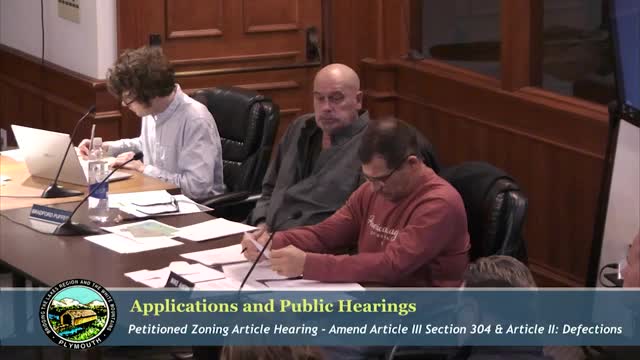
Summary
Developers and dozens of residents discussed a proposed Tenney Mountain Overlay District and its planned‑unit development (PUD) rules. The board agreed to seek legal review and to continue a public hearing on Jan. 16 to refine language on density, buildable area and environmental protections.
The Plymouth Planning Board held an extended hearing on Jan. 2 on a proposed Tenney Mountain Overlay District (TMOD) that would allow a planned‑unit development (PUD) pathway for major redevelopment and a multi‑season resort concept at Tenney Mountain and adjacent lands. Developers presented conceptual goals and answered questions; many residents and stakeholders asked for environmental safeguards and clarity about density and housing types.
Why it matters: The overlay would create an alternative set of rules for large‑scale, master‑planned developments in the Tenney Mountain area. If adopted it could enable mixed uses—including resort facilities, hotels, limited industrial/research space and a village core—through a coordinated PUD process rather than a series of piecemeal site plans.
Developers' presentation and community concerns: The Tenney Mountain team described a long‑range vision that includes added terrain and a village core designed to support year‑round activity, plus a proposed campus for higher‑paying jobs tied to science and technology. Steve Kelly, a lead developer on the project, said the intent is to create a financially sustainable, multi‑season destination that can support jobs and housing.
Many residents and conservation advocates pressed for limits and safeguards. Joan Turley, chair of the Conservation Commission, urged cautious treatment of wetlands, floodplains and viewsheds and warned that large, poorly sited development could increase flood risk. Several speakers asked for clearer language on where and how tall buildings may be, how many units per acre would be permitted and how the overlay would interact with state wetlands and drainage rules.
Board debate and next steps: Planning board members and the developer team discussed multiple technical points, including definitions of a PUD, minimum acreage thresholds (discussed in draft as 100 acres and 250 acres for different PUD types), the village core concept (draft text limited a high‑density village core to 25% of the PUD tract) and how to compute buildable acreage when wetlands and steep slopes are present.
After extended public comment and discussion, the board agreed to circulate the revised draft language for legal review and to post the updated text for a continued public hearing on Jan. 16. Planning staff and the development team asked the board for that step to keep the project moving while allowing attorney review of substantive changes.
Quote from the hearing: "With good design, they fit the character of those places," said Neil (planning board member), referring to how larger buildings can be made to match local character when they are part of a master plan. Steve Kelly said the team aims to "build a sustainable, successful community" with a mix of resort, housing and employment uses; he also said the team recognizes the need to study wetlands, drainage and roads before final design.
What remains unresolved: The board and public raised questions about whether residential uses should be permitted outside a village core, how to limit overall density across a PUD tract, how to define and measure buildable land, and whether multiple village cores should be permitted within a very large PUD. The board asked staff and counsel to bring clarifying language back for the Jan. 16 hearing.
Ending: The board took no final vote to adopt the overlay at the Jan. 2 meeting. Instead members voted to seek attorney review of the revised draft and to continue the public hearing on Jan. 16 so the board can consider final wording before placing any amendment on the warrant.