
Orland Park Public Works details snow-plow routes, GPS tracking and contractor use
Get AI-powered insights, summaries, and transcripts
Subscribe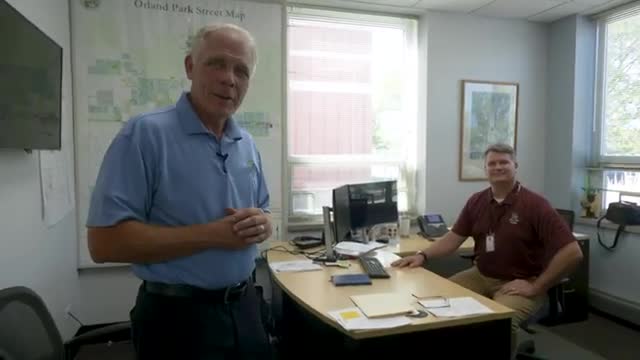
Summary
Public Works staff described how the village manages snow events across roughly 500 lane miles, including 22 plow zones, GPS tracking of plows, contractor support for deep events and fleet standardization to reduce maintenance.
Orland Park Public Works laid out how it handles snow operations during a facility tour, describing route responsibilities, equipment maintenance, GPS tracking for accountability and contractor support for large storms.
The overview matters because the village must coordinate with state, county and township agencies to determine which roads it will plow, maintain a fleet ready for successive storms and respond to resident complaints about missed or delayed plowing.
Joel Van Essen, Orland Park Public Works Director, said, "So we have, 500 lane miles that we have to plow every year. So we break up the map into 22 zones, through from the north to south." He noted the village does not plow some major roads — including La Grange Road, Harlem and parts of 153rd and 159th streets — because those are state, county or township responsibilities. "If we drop a plow on La Grange Road or we drop a plow on a 159th Street and there's any damage to those streets ... they're gonna hold us responsible for it and we don't want that so that's why we don't do that," Van Essen said.
Van Essen described the village's publicly available map that shows which jurisdictions maintain which streets and the use of contractors to support large events. "The village, has 22 routes, but there's many locations where there's dead ends and cul de sacs. And so we utilize the, contractors to help support large events, usually over 2 inches, to help clean up those courts," he said. He added that some routes can take about eight hours to complete in large storms and urged patience from residents in cul-de-sacs.
Andy, fleet manager for Orland Park Public Works, described preventive work and shop staffing. "Before before we get into the snow plowing operations, we we wanna talk about preventative maintenance. We've already begun, getting snow equipment ready, so we kind of have a head start on all of that. During snow operations, in between operations, we're going over vehicles. We're working with the operators to see if there's any issues that we have to fix." He said the garage keeps four mechanics available with overlapping AM and PM shifts: "We have we have 4 available mechanics. They do have overlapping shifts, and then we split them up between AM and PM teams."
Andy also described recent vehicle specifications the village is moving toward: "So we're basically standardizing drivetrain across the across our fleet, but we're going with a PACCAR chassis which is, Peterbilt or Kenworth, Cummins engine, Allison transmission, and then also the stainless steel body with the v box insert. The stainless steel will hold up a lot longer with a lot less maintenance than the standard carbon steel bodies."
Van Essen and staff also described GPS tracking used during storms. "We actually have GPSs on the vehicle and we know when they were on certain streets, what time, what time they're in front of your house, to to the second. We know exactly where they were. And that's important because we do get, as you can imagine, the mayor's office gets a lot of complaints from people sometimes that say you've never plowed when in fact we had. We just maybe plowed early in the snowstorm or something like that. So we have all that information," Van Essen said. The village's map view shows blue lines and time stamps indicating when a plow passed, and those lines fade to show frequency of coverage.
Staff described how they time call-outs. Van Essen explained they monitor forecasts and provide operators enough time to travel from home to work while allowing snow to accumulate so crews can push snow effectively: "We're projecting, based on the the weather data of when we should call the, our folks back in. Obviously, they live in a variety of areas and they have to come in. So we provide enough time for them to come, but also to allow some of the snow to be on the street. So when they get into the, routes that they're actually pushing, snow."
Staff said the GPS tracking also supports training and complaint resolution by showing when and where plows operated during a storm.
The discussion was descriptive and operational; no formal policy changes, votes or budget actions were recorded during the session.