
District outlines student‑assignment plan, modular relocations and bus-travel study ahead of September redistricting recommendations
Get AI-powered insights, summaries, and transcripts
Subscribe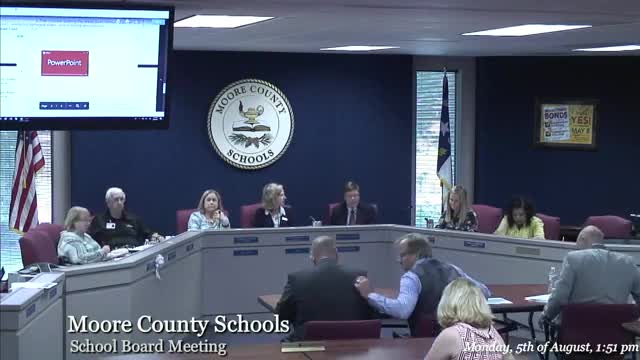
Summary
Moore County Schools presented guiding principles for district-wide student assignment, plans to reuse modular classrooms to relieve middle-school capacity, and a transportation analysis of bus-travel impacts for draft reassignment scenarios.
District staff presented a multi-part plan Aug. 5 that pairs student‑assignment planning with modular-unit relocations and a traffic/transportation analysis to limit negative operational impacts as the district opens three new elementary schools and adjusts attendance boundaries.
John Barath and others summarized the district’s guiding principles for reassignment — balance, efficiency, planning and community — and described the data driving options: long-range enrollment projections presented to the board in 2018 and updated through 2019. Staff said growth at middle and high schools has produced heavy use of modular classrooms: Union Pines had 18 modular units and Pinecrest High School 17 (numbers provided in presentation). The district’s modeling shows specific middle schools could substantially exceed their core capacities over the next decade if assignments do not change.
Staff proposed reusing modular units moved off the Pinehurst temporary site as an economical near-term remedy to serve growth without immediate new construction. The plan included moving a six-classroom modular from Northmore High School to Cameron Elementary in 2021 and relocating other surplus units to Cranes Creek Middle School to bring its classroom capacity toward its built core capacity (700 students). Officials emphasized units in poor condition would be declared surplus rather than refurbished.
Barath said the choice is move-or-sell: selling used units tends to recover a small amount (staff estimated sale proceeds near $5,000 per unit) compared with the replacement cost of acquiring comparable units later. Staff argued retaining and relocating suitable units would be more cost-effective if re-use is likely within the planning horizon.
Consultant Josh Ranke of Ramey Kemp and Associates presented a countywide transportation assessment focused on key corridors (Midland Road roundabout, the NC 5 corridor and the Morganton/US‑1 corridor). Ranke said field data collectors ran repeat loops during morning peak windows and that the team also used Synovia GPS route data from buses to compute route times. "We were brought on board to look at the impacts of the potential redistricting on travel times," Ranke said.
Districtwide route-time findings showed wide variation: median and average route times differ by school level and attendance area. Ranke and staff gave example neighborhoods and projected travel-time comparisons under draft scenarios: a J. Dowdy Road sample showed approximately 52 minutes to either school option (below district elementary averages), while an Eagle Springs sample showed roughly 1:13–1:23 travel times depending on the school assigned. Staff noted exceptional‑children routes can show large outliers (one maximum recorded afternoon EC route of 3 hours, 37 minutes in the dataset) but said those are not the norm and that averages are lower.
Staff reiterated the public will have additional chances to comment: staff planned to present formal reassignment recommendations Sept. 3 and hold a public hearing Sept. 12 at 6 p.m. Board members asked for visual comparisons showing “what would have been” versus “what would be” after reassignment; staff said they would attempt to produce school‑by‑school charts for the September meeting. The district cautioned that homes approved for development after the enrollment study (e.g., a new Blake Village parcel off NC‑5) will be folded into updated projections.