
Residents press Oklahoma City Council over police use of force; city outlines administrative review and defers settlement resolution
Get AI-powered insights, summaries, and transcripts
Subscribe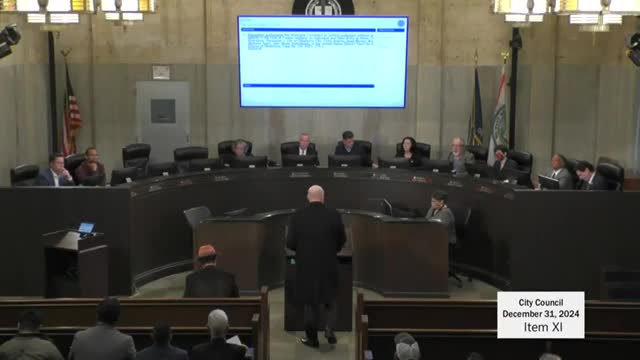
Summary
Dozens of residents, many from Oklahoma City’s Asian and Vietnamese communities, urged council action after video showed an officer using force on a 70‑year‑old man. City officials described the police department’s internal review process; the council deferred a pending settlement resolution for two weeks.
Dozens of residents told the Oklahoma City Council on New Year’s Eve that the city must hold officers accountable after video circulated showing a city police officer using force on a 70‑year‑old man with limited English proficiency. Speakers repeatedly urged the council and city manager to remove the officer from street duty and to change training and reporting practices.
The comments came during the citizens-to-be-heard portion of the meeting. John Kaufman, who identified his address as 2301 Northwest 156, appealed to council members to “do what’s right” and suggested the family of the injured man be paid an amount equal to officers who were on administrative leave. Cindy Winn, a co‑founder of the Asian Task Force of Oklahoma, described being personally affected by language barriers in police interactions and called the officer’s use of force “not only dangerous” but costly to taxpayers when incidents lead to settlements.
Tazeem Al Michael, a community engagement manager with the Center for Community and Justice, cited citywide statistics on police use of force and urged the council to require verbal warnings before force, to ensure full reporting of force incidents and to partner with culturally equipped community organizations for training. Several other speakers, including Quang Pham, Garland Pruitt and Scarlet Lee Kao, asked the city to strengthen de‑escalation training and to use community translators and resources when officers encounter residents with limited English.
After public comment, Councilmembers discussed the administrative process that follows a criminal review. City staff said the Police Department’s Office of Professional Standards conducts an internal investigation once criminal questions are resolved. That internal review produces recommendations that go to Police Chief Bassey, whose disciplinary recommendations are then addressed by the city manager’s office; the city manager retained ultimate responsibility for personnel actions under the council‑manager form of government. City officials also said the Public Safety Advisory Board will review the incident after discipline decisions are made and may recommend broader policy or training changes.
Mayor and council members clarified that, under the collective bargaining agreement with the Fraternal Order of Police, uniformed officers have due‑process rights and that any disciplinary decision could be subject to grievance or arbitration. As the city manager explained, that process gives officers the right to respond before final discipline is imposed.
The meeting included a pending resolution (item Z‑1) authorizing a settlement in a separate police‑related case; after returning from executive session the council voted to defer action on Z‑1 for two weeks so members could receive additional information. The motion to defer passed and the item was rescheduled for the Jan. 14 agenda.
The council did not announce a final disciplinary outcome for the officer referenced by speakers at the meeting. Officials said the internal investigation and due‑process steps were ongoing and that the city would engage the Public Safety Advisory Board to review training and policy implications once the internal process is complete.
Community members at the meeting asked the city to use community organizations as translation and training partners and to adopt clearer de‑escalation requirements and full force reporting. City officials said those suggestions would be part of the Public Safety Advisory Board’s review.