Get Full Government Meeting Transcripts, Videos, & Alerts Forever!
Get email alerts on the Behavioral Health Spending topic
No spam. Unsubscribe anytime.
OCA work group debates what counts as behavioral health spending for new state measurement
Summary
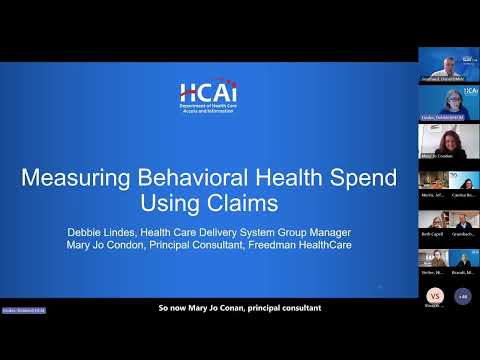
Margaretta Brandt, assistant deputy director for health system performance at the Office of Health Care Affordability, opened the Investment and Payment Work Group meeting in December 2024 to focus on how to define and measure behavioral health spending using claims data.
Margaretta Brandt, assistant deputy director for health system performance at the Office of Health Care Affordability, opened the Investment and Payment Work Groupmeeting in December 2024 to focus on how to define and measure behavioral health spending using claims data.
The discussion centered on the OCAproposal to measure total behavioral health spending broadly while using a narrower subset of codes and settings to set an investment benchmark. OCA staff said they plan a phased approach that begins with the commercial and Medicare Advantage markets, will adapt definitions for MediCal later, and will iterate the code set over time.
Why it matters: the state statute directing OCA requires measurement of behavioral health spending as a share of total medical expenses. How OCA chooses diagnoses, services, places of service and drug codes will determine reported totals and what counts toward any future investment benchmark intended to increase behavioral health capacity and culturally responsive care.
OCA staff described the technical approach and sources: they plan to start from the Milbank Groupspecifications (which rely on HEDIS value sets and state code lists), review Department of Managed Health Care and MediCal code sets for alignment, and then publish a draft ICD-10/procedure/drug code list for work group review. Staff also noted they will use CMS place-of-service codes and National Uniform Billing Committee revenue codes to organize care settings.
Key points of debate
- Diagnosis inclusion: Work group members debated whether to include dementia (major neurocognitive disorders), autism and "adverse effects of poisoning/self-harm" codes. Massachusetts and Rhode Island include dementia in their definitions; Maine does not. Massachusetts includes autism; Maine and Rhode Island do not. Maine and Rhode Island include poisoning/self-harm; Massachusetts does not. Clinicians and advocates argued dementia and autism have important behavioral-health components and that excluding them could miss substantial behavioral services. Others urged caution because some services tied to those diagnoses are primarily medical and may inflate behavioral totals if counted indiscriminately.
- Services and drug spending: Milbank includes prescription drugs via national drug code lists. OCA staff asked whether to include pharmacy spending in the numerator for the measurement and whether to include it in the benchmark; that question remained under consideration. Stakeholders emphasized federal mental health parity rules and recent California coverage mandates that affect what commercial plans must cover (commenters noted some autism services and dementia-related services fall under those rules).
- Care settings and subcategories: Staff recommended organizing spending into subcategories (for example, inpatient facility, inpatient professional, outpatient professional, community-based, telehealth, mobile) to allow roll-ups and targeted benchmarking. Some participants urged that emergency department and inpatient/residential services be included in measurement because they are important points of access and reflect real unmet need; others said the benchmark for new investment might focus on outpatient and community-based services.
- Practical coding concerns: Multiple commenters asked for the actual code lists (ICD-10, procedure, drug, place-of-service) to judge inclusion precisely rather than discussing categories alone. Several participants noted claims data limitations: hospital claims with a behavioral diagnosis may include substantial nonbehavioral care (for example, hip fracture care coded with dementia as a diagnosis), and counting those encounters can misattribute spending unless services/procedure codes are also used.
Agreed directions and next steps
- OCA will use Milbank specifications as a starting point, review DMHC and MediCal code sets for alignment, draft a detailed code set (diagnosis, procedure, revenue, NDC lists) and circulate it to the work group for review prior to board recommendations.
- Initial measurement will focus on commercial and Medicare Advantage claims submissions; OCA will adapt definitions for the MediCal/medical market in a later phase and will develop non-claims measures in future meetings.
- Staff and consultants will produce subcategory groupings that support public reporting and allow a possible benchmark that emphasizes outpatient and community-based services while still capturing total behavioral health spending for context.
Quotes (selected, verbatim)
"OCA statute requires us to measure behavioral health spending as a percentage of total medical expenses," said Debbie Lindes, manager of the Healthcare Delivery System Group at the Office of Healthcare Affordability.
"The Milbank work gives us a useful head start on our work," Mary Jo Condon, principal consultant with Friedman Healthcare, said when introducing the proposed code-driven approach.
"I would strongly recommend that dementia should be included. I also agree that autism should be included," Parnika (psychiatrist, representing the California State Association of Psychiatrists) said, adding clinicians often treat psychiatric symptoms that accompany neurocognitive disorders.
"From the hospital association perspective ... emergency department visits can be a critical place that at least people are accessing care," one participant said, arguing ED and inpatient encounters should be counted in measurement.
What was not decided
No formal vote or board decision was taken. OCA did not finalize whether pharmacy spending will be counted in the numerator or what exact diagnosis or procedure codes will be included. The work group requested the specific code sets for detailed review before settling inclusion/exclusion choices.
Context and background
OCA staff emphasized they will treat the benchmark as a subset of total measured behavioral health spending: measurement aims to capture the full universe of behavioral-health-related claims and associated spending, while a benchmark could reasonably focus on increasing investment in outpatient and community-based behavioral services. Staff reiterated the phased approach starting with commercial and Medicare Advantage markets and later addressing MediCal and non-claims spending.
Ending note
Staff closed by saying the work group will continue the discussion in January and will begin reviewing provider inclusion and non-claims measurement in future meetings. OCA invited email input and said a draft code set would be shared for review.