Get Full Government Meeting Transcripts, Videos, & Alerts Forever!
Get email alerts on the Fentanyl topic
No spam. Unsubscribe anytime.
Farmers Branch forum warns ‘one pill can kill,’ outlines school, first-responder steps
Summary
Federal and local officials, laboratory staff and Carrollton-Farmers Branch ISD leaders met in Farmers Branch for a community briefing on fentanyl trends, testing and responses; officials urged parental vigilance, said schools carry naloxone and described rising frequency of lethal pills.
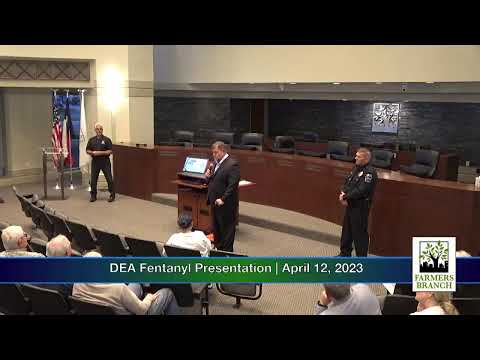
Farmers Branch hosted a community fentanyl awareness presentation led by Drug Enforcement Administration officials, the DEA regional forensic laboratory and local public-safety and school leaders, who urged parents and residents to monitor social media and student activity and stressed that “one pill can kill.”
The forum brought together Assistant Special Agent in Charge Guy Baker of the DEA’s Dallas Field Division, regional lab staff, Farmers Branch Police and Fire Department leaders, and Carrollton-Farmers Branch Independent School District representatives to describe how fentanyl is appearing in pill, powder and edible forms and what first responders and schools are doing to respond.
The DEA presenter emphasized the potency and changing pattern of illicit fentanyl in North Texas and nationwide, saying the drug is often pressed into counterfeit oxycodone tablets and mixed into other forms. “One pill can kill,” a DEA speaker said, summarizing lab and overdose trends the agency is tracking.
Assistant Special Agent in Charge Guy Baker said the DEA and its lab in Dallas work with state and local partners to target distribution networks, and noted that laboratories now see fentanyl in an increasing share of evidence samples. Regional lab director Jerry Walker described laboratory testing showing a rise in tablets that contain potentially lethal doses and the variety of ways fentanyl is packaged and pressed into pills.
Officer Steve Rutherford, a crime prevention specialist with the Farmers Branch Police Department, introduced the panel and framed the evening as an education event for parents and community members: “we're gonna educate ourselves a little bit on this.”
Carrollton-Farmers Branch ISD leadership described district-level prevention and response: Jo Gillen, speaking for the district, said schools have delivered age-appropriate education and counseling and urged parents to be active in monitoring devices and social accounts. “You are the parent. I often say you are the CEO of your home,” Gillen said, urging families to check social media and devices.
District and EMS officials confirmed naloxone (Narcan) availability. An ISD representative said Narcan is stocked at every campus and that some secondary campuses hold multiple doses. Farmers Branch EMS Captain Terry Evans described first-responder protocols and dosing, and said emergency crews and police are equipping staff with naloxone and training. “You're not going to harm anybody by giving them multiple doses of Narcan,” Evans said, describing the agency's procedures to restore breathing and transport patients for further care.
Presenters reviewed trafficking and production details that drive availability: agents described kilo-scale shipments and small, high-volume pill presses that convert grams of fentanyl into hundreds of thousands of pills, and identified Mexican cartel groups as sources of much of the illicit supply. Speakers warned that pills sold online or passed among friends may look like legitimate pills but have no quality control and can vary widely in fentanyl content; lab staff described instances where some tablets tested at several milligrams — and sometimes higher — of fentanyl.
Officials and school staff repeatedly urged parents to talk with children, monitor social accounts and report concerns to school resource officers. DEA and lab staff offered resources, including the agency website (dea.gov) and lab-produced materials, and said the DEA will continue public outreach and training with local partners.
Audience questions focused on how students obtain pills (social media, friends, after-school gatherings), how pills are delivered (mail and concealment in vehicles), how to recognize overdose (slow breathing and pinpoint pupils), and how schools and parents can respond. District counselors and licensed chemical dependency counselors introduced themselves as contact points for families seeking help.
No formal votes or policy actions were taken at the meeting. The event combined technical remarks from DEA lab staff about testing and composition, operational comments from federal and local law enforcement, and practical prevention and response information from school and EMS officials. The presenters provided sources for further information and encouraged community-level vigilance and conversations with young people.
Sources and direct quotes in this article come from the event transcript and are attributed to named speakers who appeared on the program.