Get Full Government Meeting Transcripts, Videos, & Alerts Forever!
Get email alerts on the Redistricting Maps topic
No spam. Unsubscribe anytime.
Farmers Branch panel narrows redistricting options, sets June 7 council presentation and flags census blocks for review
Summary
The Farmers Branch Redistricting Advisory Committee agreed on a primary map, created a secondary “map 6” to give City Council options on June 7, and identified several large census blocks it will ask the city and Census Bureau to examine before the next redistricting cycle.
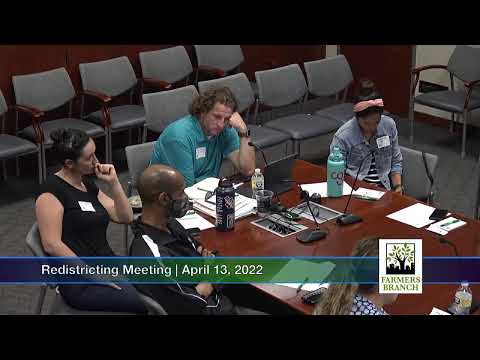
The Farmers Branch Redistricting Advisory Committee agreed Tuesday to advance a primary map and save a second, preliminary option for City Council, and to submit a list of problematic census blocks for further review.
Committee leaders said they will present two options to the council at its June 7 meeting — the primary map the committee previously endorsed and a newly saved alternate labeled “map 6” — and will ask the council to consider requesting changes to several large census blocks that the committee says make fair districting difficult.
“We've unanimously agreed upon a map,” the Meeting Chair said during the session, adding that the group had produced a secondary option so councilors would “have more than one option to choose from.” The committee set its presentation for the Tuesday, June 7 City Council meeting, which the chair said typically begins at 6 p.m.
Why this matters: The committee told the council it wants to give elected officials both a primary choice and an alternate so the council can pick between compactness and other neighborhood-preservation goals. Committee members said some large census blocks — including one that follows a creek and others that run along railroad or highway corridors — prevent the panel from drawing contiguous, neighborhood-centered districts without splitting a single census block.
Most important facts - The committee voted to approve its March 23 meeting minutes (motion approved unanimously at the start of the meeting). The vote carried with an “Aye” from members present. - The committee reaffirmed the previously favored map (referred to in the discussion as “map 4”) and saved a draft alternate labeled “map 6” to present to City Council on June 7 at 6 p.m. - Committee members instructed staff to compile a short list of census blocks they consider “problematic” for future block-boundary review and to include those in their materials to council; staff noted the Census Bureau’s Boundary and Annexation Survey (BAS) and other local boundary review processes will be the procedural route for any block changes.
Discussion and numbers cited Committee members discussed population deviation and how moving a handful of census blocks changes district deviation measures. The Meeting Chair said map 6 increased deviation about “seven tenths of a percent” compared with the group’s primary map but made some districts more compact. The chair also said, using the committee’s local counts, that one concentrated neighborhood (Johnson Creek) contains about 1,920 people and that a small corner census block contains about 1,382 people; the chair noted district 4 is roughly 209 people below the ideal while district 5 is about 77 people above the ideal based on the current plan.
Legal and policy constraints Committee members repeatedly flagged two practical constraints: (1) incumbents and declared candidates already living near district borders limit how far the group can redraw some lines without dramatically reconfiguring other districts; and (2) the committee’s charge is to use current census numbers rather than to project future development. “Stay within the 10%,” Bob, a staff member, said when advising members about acceptable deviation ranges and the limited flexibility that creates.
Census-block work and next steps The committee asked GIS staff to extract the specific census-block identifiers for the areas the group marked as problematic and to prepare exhibit maps for council. Sherry, a GIS staff member, explained the Census Bureau will accept local input and that the Boundary and Annexation Survey is one of the standard ways the city can submit geography changes for future block-boundary review. The panel discussed submitting a report or supplemental recommendation to council that would both present the two maps and list the census blocks they want the city to request be split or otherwise reconfigured.
Members said they will not base their maps on anticipated development. “We need to address our numbers today,” the Meeting Chair said. Several members added that, while some areas are clearly entitled to future growth, the committee’s formal task is to use current data and minimize deviation now; post-election or post-census adjustments could be considered later.
What the committee decided - Save the draft alternate “map 6” as a secondary option and publish both maps for the council packet. - Present maps to City Council on Tuesday, June 7 (6 p.m.). Members were encouraged to attend the council meeting so they can answer questions during the public hearing or presentation. - Package a short list of identified census blocks and supporting maps and ask council to include those blocks in a recommended review (staff to prepare block IDs and exhibit maps).
What remains unresolved The committee did not change districts 1–3 materially in the new alternate; most adjustments affected districts 4 and 5. Members agreed they may re-open limited adjustments after election results if those results materially alter the political geography, but several members warned against reshaping maps to favor or presume particular electoral outcomes.
The committee scheduled further internal meetings to finalize the exhibits and census-block list and to finalize the two-map presentation for council. The panel adjourned after the schedule and next steps were confirmed.