Get Full Government Meeting Transcripts, Videos, & Alerts Forever!
Get email alerts on the Redistricting topic
No spam. Unsubscribe anytime.
Farmers Branch committee adopts compact Map 4 as its primary redistricting recommendation
Summary
The Farmers Branch redistricting committee voted unanimously to endorse Map 4, citing cleaner lines, lower population deviation and stronger Hispanic voting‑age population in two districts; staff will prepare a report for City Council review.
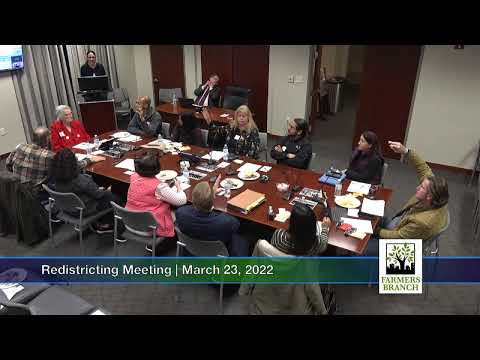
FARMERS BRANCH, Texas — The Farmers Branch Redistricting Committee voted unanimously on March 23 to endorse “Plan 4” as its primary recommended map for city council consideration, the committee chair said after a roll call. The committee cited cleaner lines, improved compactness and a lower overall population deviation (reported at 3.37 percent for Plan 4) as reasons for the choice.
The vote followed several hours of discussion comparing three alternative maps the committee had been testing (“Map 3,” “Map 4,” and a revised “Map 5”). Committee members debated whether to prioritize the tightest numerical deviation between districts or a map with straighter, more compact boundaries. Staff displayed side‑by‑side demographic figures and voting‑age population numbers for Districts 1 and 2 and ran compactness checks during the meeting.
Chair (unnamed) opened the redistricting item after approving minutes from the March 9 meeting. Staff member Sherry walked the group through the redraws and the changes between the plans, noting that the principal alteration in Plan 4 was a straightening of a jog that reduced oddly shaped “fingers” between Districts 1, 2, 3 and 5. Several committee members described the result as “cleaner” and more defensible visually.
Committee legal adviser Bob flagged the limitations of the data the group was using and reminded members of the legal context: “the numbers that we’re working from are 2 years old,” and those census numbers serve as the legal baseline for the decade. He also reviewed litigation risks and said both plans under consideration “are okay, and with the past legal muster, I think 4 looks a little better,” adding later that a court challenge might focus on racial bloc‑voting allegations but that he did not see a likely Shaw v. Reno problem in either option.
The committee also cited the city charter’s direction on incumbency and candidates. As a committee member read from the charter during the meeting: “The reconfiguration of district shall be neutral as to incumbent or potential candidates.” Members said they had considered that instruction when weighing where to draw lines near existing and potential candidate addresses.
On demographic tradeoffs, staff reported that Plan 4 produced slightly higher Hispanic voting‑age percentages in key districts than the current baseline and modest improvements versus the earlier maps: for example, committee discussion cited District 1 at about 79.10 percent Hispanic total population under Plan 4 and District 2 at roughly 56.8 percent (figures were presented by staff during the meeting). Some members emphasized avoiding “packing” — putting too many voters of one group into a single district — while preserving opportunities for representation.
After the discussion the committee took a formal vote to name Plan 4 its top recommendation. The chair called for hands and the committee recorded an 11‑0 vote in favor of Plan 4. Earlier in the meeting the committee also approved the March 9, 2022 minutes by voice vote (motion carried unanimously).
Next steps: staff agreed to prepare a short report and supporting materials to present the committee’s recommendation to City Council at an upcoming meeting or study session. Committee members said the presentation should be concise and include the comparison figures and a compactness check so councilors — and the public — can digest the tradeoffs before any formal council action.
The committee emphasized it will continue work on “good, better, best” options and could present additional alternative maps later if requested. The committee’s role will conclude after submission of its report; formal adoption of any redistricting plan rests with the City Council.