California Transportation Commission previews 2025–27 strategic plan, emphasizes safety and community engagement
Loading...
Summary
Consultants presented a preliminary 2025–27 strategic plan to the California Transportation Commission, outlining a concise mission, six goals — including prioritizing safety and elevating community voices — and next steps that include staff and Equity Advisory Committee focus groups and publishing the plan next year.
SACRAMENTO — Consultants for the California Transportation Commission on Friday presented a preliminary 2025–27 strategic plan that centers a short mission statement and six goals, and asked commissioners and stakeholders for feedback before the plan is finalized and published next year.
The consultants presented a one-sentence mission slide: “The mission of the CTC is to invest in transportation that improves communities, the environment, and the economy,” and described six goals intended to guide commission priorities, including prioritizing safety and elevating community voices, said Eileen Jacobowitz, a consultant with Sacramento State’s College of Continuing Education.
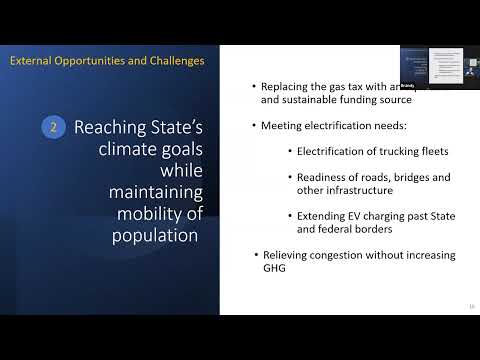
The plan emerged from an environmental scan that included one-on-one interviews with commissioners and executive managers, conversations with the commission’s Equity Advisory Committee, staff focus groups, and an anonymous staff survey. Consultant Selena Polston said that stakeholders repeatedly raised the need to fund repair and resilience of existing infrastructure, connect fragmented transit systems, reconcile climate goals with day-to-day mobility needs, and replace the gas tax.
Commissioners and advisory members used the workshop to press for clarity on implementation and outreach. Immediate past Chair Eager and others said they want the commission to move beyond receiving testimony at meetings and pursue deeper, two-way community engagement with measurable targets such as how many people were reached and how engagement informed project decisions.
Several speakers raised concern that certain interest groups can dominate public comment and urged the commission to expand outreach to underrepresented groups, including rural communities, tribal governments and working families. Commissioner Bradshaw and others highlighted that long commutes, housing shortages and uneven access to transit particularly affect working-class Californians.
Secretary Tolleson of the California Transportation Agency and Executive Director Taylor both stressed the practical limits of the commission’s staffing and budget while offering partnership options. Taylor noted the commission maintains a part‑time communications function tied to legislative work and said staff will press ahead with tactics to implement the strategic goals within budgetary constraints.
Participants suggested specific next steps: the consultants and staff will conduct additional staff and Equity Advisory Committee focus groups, integrate feedback, and publish the final plan early next year. After publication, staff work groups will identify tactics and key performance indicators and move into implementation, with some work anticipated in the spring following plan approval.
No formal votes or motions were taken during the workshop. Commissioners and stakeholders discussed policy topics including replacement of the gas tax, road user charging, tolling and measurement of vehicle miles traveled (VMT), and requested the plan explicitly address implementation challenges so policy goals do not prevent projects from moving forward in parts of the state.
The commission closed the workshop with agreement on the next steps: more focused outreach, refinement of goals into tactics and KPIs, and publication of the final plan next year. The commission will reconvene for a regular hearing at 1 p.m., the chair said.