
County engineering study finds bulk of storm drains are corrugated metal, estimates $3.8 million to replace assets
Get AI-powered insights, summaries, and transcripts
Subscribe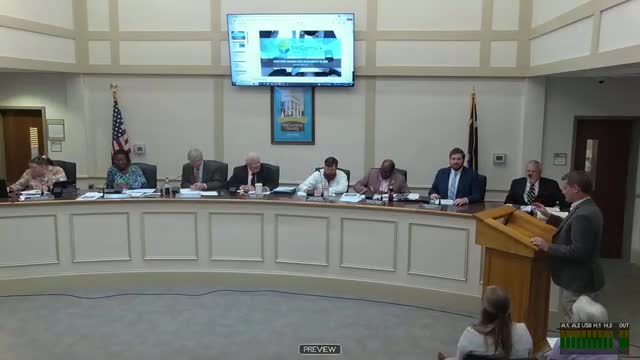
Summary
A county-funded drainage study inventoried McCormick County’s roadside drainage, found about 28,282 feet of county-owned pipe (504 culverts/pipes), noted heavy reliance on corrugated metal pipe, and presented a capital plan that would require millions in funding over the next decade to replace priority assets.
William Lamb, a project engineer with Thomas & Hutton, presented the long-awaited countywide drainage study to McCormick County Council on Oct. 21, outlining an inventory of the county’s drainage infrastructure and a funding plan to address deferred maintenance and failing pipes.
Lamb said the firm cataloged county-owned drainage within road rights-of-way and found roughly 28,282 feet of storm drain pipes and about 504 individual culverts and pipes. He noted that about 77% of the county’s drainage pipes are corrugated metal pipe (CMP), a material with a limited lifespan. “We concluded that the county owns approximately 28,282 feet of storm drain pipes,” Lamb told council.
Why it matters: the study converts field observations into a capital improvement plan (CIP) and a funding roadmap. Thomas & Hutton estimated a total replacement cost of roughly $3.8 million in today’s dollars for county-owned drainage assets and proposed priority groupings (urgent, high, medium, low) and a funding plan that could be phased over 10–15 years.
Key findings and recommendations
- Inventory and condition: The firm documented location, material, size and condition of visible drainage assets in county road rights-of-way; the study excludes drainage located off right-of-way because the county does not own those facilities.
- Material concern: About 77% of county pipes are CMP, which Lamb said commonly has a shorter useful life and therefore should be planned for replacement on a multi-year schedule.
- Maintenance plan: The study includes a maintenance list targeting features clogged with sediment or debris; Lamb showed photos of culverts partially filled with sediment as common field observations.
- Capital improvement plan and costs: Thomas & Hutton grouped replacement needs into four priority levels and produced planning-level cost estimates. Replacing all identified infrastructure now was estimated near $3 million; by 2035 the same work was projected in the study to cost roughly $3.7–4.0 million after inflation assumptions. The study estimated that addressing all county-owned infrastructure by 2035 would require approximately $330,000 annually; limiting work to urgent, high and medium projects would require about $127,000 annually.
- Funding options: The report reviewed funding mechanisms used across the Southeast, noting that many jurisdictions use a stormwater utility fee based on an ERU (equivalent residential unit). Thomas & Hutton used sample ERU rates to show potential annual revenues for the county: roughly $150,000/year at $2 per ERU to nearly $600,000/year at $8 per ERU, with hybrid options that would target higher rates in Savannah Lakes Village and lower countywide rates.
Council reaction and next steps
Council members thanked the firm for the study and discussed how to coordinate the drainage CIP with an upcoming road study and a planned fall workshop. Council member Chuck Cook raised specific concerns about Savannah Lakes Village, saying stakeholders there had sought more direct input: “We made multiple requests for stakeholder input to this process, and they were all denied,” Cook said, adding that some of the most serious problems may be gaps in constructed infrastructure rather than just failing pipes.
County staff and the engineer agreed that the study documents county-owned assets and that some problems—especially where stormwater from county ditches flows onto private property—may require separate policy discussion and ordinance changes. Lamb and the consultant team advised the council that the study is a planning-level document and that implementing a program would require council decisions about prioritization and funding.
Ending: Council members flagged the report as a starting point for budgeting and policy work. The county will discuss funding options, potential ordinance changes and a phased approach at upcoming workshops and budget meetings.