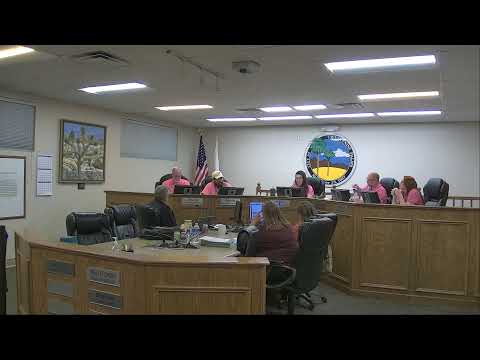
Planning commission approves 30‑unit Amboy Resort CUP after applicant and staff agree edits
Loading...
Summary
The Twentynine Palms Planning Commission approved a conditional use permit and negative declaration for a 30‑unit 3D‑printed cabin resort on Amboy Road, with modified conditions addressing septic permitting, archaeological monitoring and paving requirements.
The Twentynine Palms Planning Commission on a 5‑0 vote approved a conditional use permit and adopted a negative declaration for the Amboy Resort, a proposed 30‑unit resort of 3D‑printed cabins on the southern five acres of a 10‑acre parcel on Amboy Road.
The commission approved the Conditional Use Permit (CUP 24‑4) after the applicant agreed to edits to several conditions of approval addressing water‑quality submittals, archaeological testing and the extent of paved surfaces. The motion to adopt the negative declaration and approve the CUP carried unanimously: Commissioner Crucichet — aye; Commissioner Paul Hanna — aye; Commissioner Walker — aye; Vice Chair Garcia — aye; Chair Keur — aye.
The project applicant described the development as a small eco‑resort of 30 roughly 200‑square‑foot cabins, two community buildings (about 1,900 and 1,920 square feet), and a 3,500‑square‑foot covered patio. Parking is proposed along the southern edge of the developed half and the plan calls for no vehicle access within the core resort area; a concrete walking/golf‑cart path would provide on‑site circulation.
Jean Aldman, an applicant representative with Azure Print Homes, told the commission the units are manufactured from recycled materials and are intended to be energy self‑sufficient. "This is gonna be the first resort built with recycled materials. So some, 4,500,000, water bottles instead of going in a landfill are gonna be used to make these units," Aldman said, and described the cabins as highly insulated and tested to national standards.
Steve Enix, another project representative, asked the commission to revise three conditions. He said the project generates about 1,800 gallons per day of wastewater and, under state regional water board guidance, is below several submittal thresholds. "We see this project as exempt from their criteria because it generates 1,800 gallons per day when the criteria is 5,000," Enix said; he asked that the condition be modified to allow the applicant to obtain an exemption from the Regional Water Quality Control Board rather than require full plan submittal up front.
Enix also proposed limiting when a phase‑2 archaeological investigation would be required to only those instances where ground‑disturbing work would occur inside mapped sensitive areas, and to restrict full paving requirements to areas needed for emergency vehicle access and ADA compliance while using gravel with curbed borders elsewhere. He presented visual examples and said those changes would reduce hardscape while maintaining safety and code compliance.
Commissioners pressed for clarity on several points. The commission confirmed the developed area would be the commercially zoned southern five acres while the residentially zoned northern five acres would remain undisturbed. Commissioners were told the proposed effluent system is a centralized septic with leach fields and that the county or building official will verify whether the project qualifies for any water‑board exemption at permit stage.
Commissioner Walker said he supported the project on environmental and economic grounds. "I'm very positive on the project because I like the environmental aspects of it. It does promote one of the pillars of the city, which is tourism, which will bring in the TOT dollars to the city," Walker said.
Public comment included both support and concerns. Dane Austin, a local resident, said the resort would "represent exactly the kind of responsible forward thinking development" the city needs for tourism. Anna Stump, who lives near the dunes, voiced concern about all‑terrain vehicles and asked whether the project would fence the site; Aldman said the project would install fencing and does not intend to encourage ATV use.
Staff and the applicant confirmed cultural resources protections: archaeological monitors representing tribal nations will be present during any ground‑disturbing work near the identified sensitive areas, and the applicant proposes four‑foot picket fencing around those spots. Staff noted that even if the commission adopted the applicant's requested language changes, tribal monitoring and additional testing could still be required if the tribes request it.
In addition to the CUP approval, the commission accepted the applicants' proposed edits to Conditions E19, P9 and P6 (paving/parking language) as discussed at the hearing and directed staff to memorialize the agreed changes in the final conditions of approval.
Next steps: the applicant will return to the city for ministerial permits and inspections. Staff and the applicant said some approvals remain contingent on agency determinations (septic permitting/exemptions and any additional tribal archaeological requirements). The applicant also said it is exploring future workforce housing on the parcel's northern five acres but provided no firm plan or schedule for that potential development.
Votes at a glance
• Adopt negative declaration and approve Conditional Use Permit 24‑4 (Amboy Resort): Approved 5‑0. Commissioners voting aye: Commissioner Crucichet; Commissioner Paul Hanna; Commissioner Walker; Vice Chair Garcia; Chair Keur.