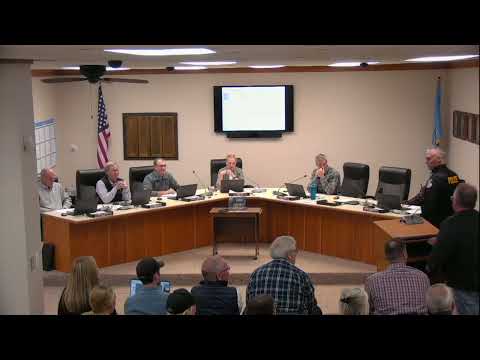
Brandon holds public hearing on rezoning 108 Park Street for proposed cell tower; no vote taken
Loading...
Summary
Brandon City Council held a public hearing during its meeting to consider the first reading of Ordinance 746, a rezoning request for 108 Park Street that applicants say is needed to site a wireless telecommunications tower to improve coverage and capacity on the city’s south side.
Brandon City Council held a public hearing during its meeting to consider the first reading of Ordinance 746, a rezoning request for 108 Park Street that applicants say is needed to site a wireless telecommunications tower to improve coverage and capacity on the city’s south side. Applicants from Elevated Towers and an RF engineer detailed site searches, technical need and federal preemption of health-based zoning denials; multiple residents and a planning commissioner urged the council to reject or further examine the location, citing schools, a flood plain and alternative locations including Aspen Park. After several hours of public comment and council questions, the council did not vote on the rezoning and moved into an executive session to consult legal counsel on potential litigation.
The applicants — Craig Snyder and Jonah Snyder of Elevated Towers and Shelly Eishens — told the council they had sought multiple possible sites during about a year of outreach and that the parcel at 108 Park Street was the only site where they secured permission from a landowner willing to host a tower. Craig Snyder said the company initially planned a 120-foot monopole but reduced the design to 90 feet to meet setback requirements for the parcel. He said the city currently has one freestanding tower and a water-tower site carrying carrier equipment and argued the south side lacks redundancy and capacity: “If a fiber optic cable gets cut, if power goes out, if weather hits … especially if it's all on one tower, you lose all three carriers in one moment,” Snyder said, urging the council to reverse a prior denial and approve the rezone so carriers can pursue a conditional use permit.
Residents opposing the proposal said the chosen parcel is too small and too close to schools and homes. Erin Taggart, of 1900 West Tyler Circle, said both Verizon and Elevated Towers’ memos identified other locations — including Hewsett Speedway and recreational areas — as the primary coverage needs and asked why the tower is being pushed adjacent to two schools. “If the racetrack doesn't want it and the true need is for that area, then why is the tower being pushed so close to two busy schools and surrounding residential areas,” Taggart said.
Megan Penning, 1301 South Fernwood Avenue, told the council the company had presented multiple private sites that were declined and she challenged the applicants’ contention that alternative public parcels, notably Aspen Park, had been infeasible. She cited prior public-record comments from Elevated Towers indicating Aspen Park had not been pursued; city staff and company representatives agreed Aspen Park had been discussed informally but said follow-up had not occurred and that any park siting would require additional code review and consideration of setbacks and future park uses. Penning also noted the company reduced the tower height from 120 to 90 feet and argued that shrinking the design undermines earlier coverage maps.
Brooke Snoham, a member of the Planning and Zoning Commission, said the commission had recommended rezoning the parcel to General Business because the site’s current Natural Resource Conservation (NRC) zoning does not fit the property’s current use and size. City staff and the commission emphasized that the council’s rezone decision is distinct from any later conditional-use-permit (CUP) review that would examine final tower siting, RF measurements and compliance with federal rules.
Gary Lysiak, a registered professional engineer with Owl Engineering, testified for the applicants on radio-frequency (RF) issues and measurement protocols. Lysiak, who previously worked with the FCC, described the technical process for measuring RF exposure and said such emissions drop rapidly with distance. He told council members he had measured hundreds of towers and had not found ground-level exposures exceeding federal standards at distances typical for monopoles taller than about 100 feet. He also noted the FCC and standards bodies set measurement procedures and that courts have limited the use of health effects as a zoning basis under the Telecommunications Act of 1996.
Applicants and residents each referenced federal and state regulatory considerations. Applicants said the Telecommunications Act and case law constrain local governments from denying applications solely over RF concerns; they also cited the National Environmental Policy Act (NEPA) and State Historic Preservation Office (SHPO) constraints as reasons some private sites (including oak ridge nursery and adjacent property) were ruled out because of proximity to archaeological features. The applicants also provided a legal letter from the law firm Kutak Rock, which they said addressed zoning and conditional-use permitting considerations.
Council members asked applicants for detailed propagation studies and data showing a “significant gap in coverage” or capacity shortfall. Elevated Towers said it had provided propagation maps to the planning and zoning commission and that carrier-specific capacity and usage metrics (such as dropped-call statistics) are often proprietary and would require carriers’ cooperation to share. Council members discussed options: approve the rezone (which would not itself authorize tower construction), deny it (which could invite litigation if the applicant can show the denial prevents the provision of commercial mobile service), or table the request to allow further site-exploration, including a focused look at Aspen Park. Several members suggested Aspen Park warranted a closer look; applicants said parks often present additional hurdles (ownership, existing and planned recreational uses, setbacks) and that Aspen Park’s northward location might be less optimal for the carriers’ propagation and capacity needs.
No council vote on Ordinance 746 occurred during the meeting. After public comment and council discussion, a council member moved to enter executive session “to consult with legal counsel pertaining to potential litigation,” and the council approved that motion by voice vote. The public hearing and first-reading matter was left open for later council action following legal consultation and any additional staff or applicant follow-up.
Why it matters: The rezoning decision could set a local precedent for where towers are permitted, and a rezone would shape what sites remain available for future telecommunication infrastructure. Residents emphasized school proximity, park usage and floodplain concerns; applicants emphasized network redundancy, capacity and federal preemption of health-based zoning denials. The council signaled it wants a more developed administrative record and legal guidance before taking a final vote.
Next steps: The council may consider the rezone at a future meeting after executive-session legal advice and any additional studies or alternatives the council requests. If the council approves a rezone later, a subsequent conditional-use-permit review would examine exact tower design, RF measurements, setbacks and interference concerns before issuance.