Get Full Government Meeting Transcripts, Videos, & Alerts Forever!
Get email alerts on the Warrant Articles Review topic
No spam. Unsubscribe anytime.
Finance Committee and Select Board review warrant articles; committees split on revolving fund and part‑time official benefits
Summary
The Town of Lakeville Finance Committee and Select Board reviewed articles for the Nov. 12 special town meeting, recommending several housekeeping and capital items but expressing disagreement on a proposed 53E½ revolving fund for conservation and a citizen petition changing health benefits for part‑time elected officials.
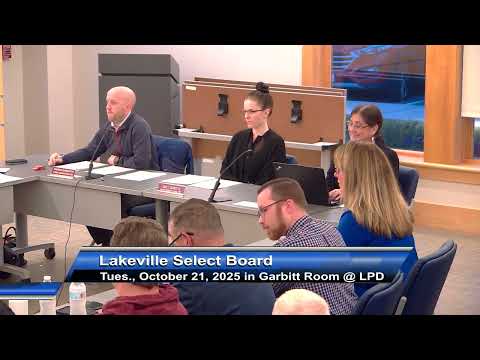
At a joint session Oct. 21, the Town of Lakeville Finance Committee and Select Board reviewed multiple warrant articles scheduled for the Nov. 12 special town meeting and recorded formal recommendations on several items.
Votes at a glance - Article 1 (pay prior‑year unpaid bills; transfer $1,360.77): Finance Committee recommended approval; Select Board recommended approval for the special town meeting. - Article 2 (amend Community Preservation Committee bylaw language to formalize CPC recommendations on at‑large appointments): Finance Committee recommended the article as presented after discussion; the article will proceed to town meeting with committee members prepared to speak to it. - Article 3 (raise/transfer $25,000 for a building study/design for reuse of the former fire station/town hall at 346 Bedford St.): Finance Committee recommended approval; Select Board recommended approval. The request lists consultant and study line‑items (architect $6,500; structural engineer $3,500; hazmat/abatement $2,500; mechanical engineering $4,000; OPM services $8,200) and positions the study as a phased, smaller‑scope alternative to a full renovation plan developed in 2022. - Article 4 (create a general bylaw to authorize Massachusetts General Law chapter 44, section 53E½ revolving funds and specifically establish a conservation revolving fund with a $15,000 spending limit): The Finance Committee recorded no recommendation after extended discussion and a split vote; the committee debated potential loss of free‑cash revenue, administrative controls, enforcement needs, and whether free cash appropriations would be preferable for infrequent needs. The Select Board likewise did not reach a unified recommendation at the meeting. - Article 5 (citizen’s petition to bar part‑time elected officials from participation in the town’s contributory health and life insurance plan effective 03/01/1926): The Finance Committee initially debated and a majority favored referring the item to town meeting for debate; the Select Board voted not to recommend support of the article as written and discussed an amendment from the floor to change the effective date to the end of current officeholders’ terms.
Article 4: revolving fund debate Finance Committee members and conservation staff framed the revolving fund request as a modest, recurring tool to allow conservation to spend fees and dedicated receipts (typically $6,000–$8,000 per year historically) without repeatedly returning to town meeting for small appropriations. Conservation argued the fund would enable paying for needed technical work — for example, hiring consultants to draft a local wetlands bylaw tailored to Lakeville’s significant wetland acreage. Several finance members expressed concern that moving existing receipts out of the general fund reduces free cash available for broader budget needs and could invite other committees to request similar authority, increasing fragmentation of revenue. One finance member cited risks of misuse if funds were not tightly controlled.
Article 5: citizen petition on part‑time official benefits A citizen petitioner reviewed the town’s historical practice of offering health‑insurance buyouts or coverage to certain stipended boards and argued the town should end eligibility for part‑time elected officials, citing projected long‑term costs if participation continued. Select Board and Finance Committee members discussed legal constraints, the Superintendent/Town Counsel guidance that benefits cannot be applied in a discriminatory way, historic cost‑sharing splits for municipal coverage, and the political optics of ending benefits mid‑term. Select Board members noted amendments could be proposed from the floor at town meeting (for example, carrying existing coverage through the current officeholder’s term but changing eligibility for newly elected members).
What’s next - Several articles will move to the Nov. 12 special town meeting with presentations from committee members; Article 4 will appear on the warrant but with no recommendation from the Finance Committee; Article 5 will go to floor debate and may be amended there.
Ending: The joint session closed after the committee voted on its recommendations and scheduled remaining warrant business for follow‑up ahead of the special town meeting.