
Russell County Fiscal Court holds first reading of ordinance to regulate large-scale solar projects
Get AI-powered insights, summaries, and transcripts
Subscribe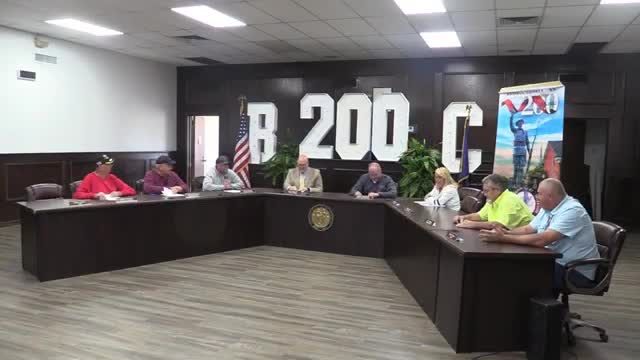
Summary
At a special meeting Oct. 22, the Russell County Fiscal Court conducted the first reading of Ordinance 25-10, proposing licensing, setbacks, screening and decommissioning requirements for large-scale solar energy systems in unincorporated Russell County. No final vote was taken; a second reading was discussed for early November.
The Russell County Fiscal Court held a special called meeting Oct. 22 at 10:00 a.m. for the first reading of Ordinance 25-10, a proposed county ordinance that would establish licensing, setback, screening and decommissioning requirements for large-scale solar energy systems in unincorporated Russell County.
The ordinance would require responsible entities to obtain a county solar energy license before beginning physical construction of a large-scale solar energy system (SES), submit detailed site plans and lists of participating properties (including tax parcel numbers and addresses within 2,500 feet of the proposed SES footprint), and post and periodically update a surety to cover decommissioning costs. "It's about a 14 page ordinance," the presenter summarized, noting the court would set any application fee by resolution following adoption (Kevin, staff member).
The ordinance text presented at the meeting includes the following major provisions: a 2,000-foot minimum setback from any nonparticipating property line and from public rights-of-way; controlled access with an at-least-8-foot fence plus vegetative screening (described as a double-staggered row of evergreens with 90% opacity and minimum initial heights); screening to be installed within 180 days of the start of construction and maintained through decommissioning; lighting limited to the minimum needed for safe operation and shielded to avoid light trespass; and a required decommissioning plan prepared by a registered professional engineer with an accompanying surety instrument that must be updated at least every five years. Under the draft ordinance, decommissioning must begin no later than 12 months after a facility ceases generating energy and all equipment and foundations must be removed within six months after decommissioning begins.
The ordinance includes licensing timelines: applicants would receive a county decision within 60 days of a complete application and the county judge/executive would issue a license or denial within 30 days following the court's action. The draft also contains a license-revocation process that would begin with a 90-day notice to correct violations, and an amended-license requirement on any transfer of facility ownership.
Several residents raised concerns during public comment about local impacts. One resident said drilling and ground disturbance associated with recent solar projects had damaged private wells and left some households without drinking water; the speaker urged that the ordinance address well protection and testing. Another public commenter asked that waterways and definitions of what constitutes a waterway be added to setback language. Battery storage also drew questions: a resident asked whether county fire services have equipment and training to handle lithium-ion battery fires and whether battery storage should be addressed explicitly in the ordinance.
Court members and staff discussed legal risks and precedent. The presenter cited KRS 67.083 and KRS 278.718 (effective June 29, 2023) as bases for local ordinance authority and noted a circuit-court decision in Caldwell County that upheld a local ordinance in similar circumstances, while acknowledging the possibility of further appellate review. Court members discussed the difference between home-rule authority under KRS chapter 67 and zoning/planning requirements under KRS chapter 100; the presenter said legal questions remain about whether KRS 100 could limit the county's authority and that such questions could be litigated.
Other topics discussed included a cumulative-footprint rule in the draft that would bring an existing SES under the ordinance if its footprint increases by more than 5% after the ordinance's effective date; whether the county could limit the total acreage of solar in the county or set maximum project terms (the presenter said such limits could be added but might raise legal scrutiny); and who would conduct inspections (the court could perform oversight, delegate to a third party, or hire consultants or engineers paid for by applicants).
Court members noted there are multiple proposed projects in early stages across the county; a speaker told the court there were five projects in initial stages. The presenter said projects that had received final state approval before the county ordinance took effect could be grandfathered, citing the Caldwell County matter as an example where previously approved projects were not subjected to the new local ordinance in the same way as new projects.
No final vote on Ordinance 25-10 occurred at the meeting; the item remains at first reading and the court discussed scheduling a second reading. Because of legal advertising requirements and the county's weekly newspaper publication schedule, staff said the earliest lawful second reading would likely be Nov. 10. The meeting closed with a motion to adjourn that carried.
What’s next: The court asked members to submit any requested changes before the second reading so staff can circulate a clean draft for the final vote. The court also signaled it will decide by resolution whether to set an application fee to cover review costs, including potential outside engineering or inspection expenses required to evaluate applications.