Pitkin County planning commission reviews Vision 2050 housing policies; debates CDUs, water limits and in-lieu fees
Loading...
Summary
Planning and Zoning commissioners reviewed a consolidated "community housing" chapter of the Vision 2050 comprehensive plan on Oct. 21, 2025, focusing on locating housing within urban growth boundaries, clarifying caretaker dwelling unit rules, water-system capacity, and tensions over payment-in-lieu mitigation fees.
Pitkin County Planning and Zoning commissioners on Oct. 21, 2025 reviewed a consolidated community housing element of the Vision 2050 comprehensive plan and discussed where and how the county should encourage housing for workers, seniors and families.
The work session focused on four primary issues: prioritizing housing inside urban growth boundaries (UGBs); criteria for limited, small-scale housing adjacent to UGBs; tightening rules and enforcement for caretaker dwelling units (CDUs), including a proposed increase in CDU size to 1,500 square feet; and whether on-site deed-restricted housing should be preferred over payment-in-lieu mitigation fees.
The discussion matters because the commission’s policy direction will guide forthcoming land-use and code changes, implementation actions and future development approvals across the county. Commissioners and staff framed the debate around competing goals in Pitkin County: preserving rural character while increasing housing availability and affordability for local workers and residents.
Hannah Hunt Wanders, senior long-range planner for Pitkin County, opened the presentation by identifying the agenda and process. "This is the fourth work session for the comprehensive plan," Hunt Wanders said, describing how the Vision 2050 project has consolidated housing policy into the built-environment chapter and will feed a final draft that moves through public hearings and Board of County Commissioners review. Staff reiterated that the consolidated housing policies reflect prior outreach, a Growth Advisory Committee report and recent community mapping charrettes held in Aspen, Basalt, Carbondale, Snowmass Village and online.
Staff presented the draft policy framework and criteria for locating community housing outside UGBs. The draft says such housing should be "adjacent to or within an existing community water system or municipal water district service area with an available and reliable water supply and capacity to serve additional units," close to transit or transportation corridors, avoid natural hazards and wildlife habitat, and be limited to small-scale types (for example, small single-family homes, compact attached units or clustered developments up to roughly 10 dwelling units). Hunt Wanders emphasized water capacity as a key limiting factor and said staff would define technical terms such as "community water system."
Commissioners and participants pressed for clarity and implementation detail. Commissioner Suzanne Caskey welcomed language intended to keep occupants tied to the community, praising the inclusion of the phrase "contribute to." "I'm happy that you added those words," Caskey said.
Joe Mason, participating remotely, raised concerns that the term "community housing" overlaps with "affordable housing" and urged sharper definition and potential implementation mechanisms. "I don't see the distinction between this and affordable housing," Mason said, asking whether the plan should describe the types of subsidies, tax exemptions or other tools that could increase access.
Staff said the intent of the broader "community housing" term is to encompass deed-restricted affordable units as well as other local-occupancy tools such as CDUs, accessory dwelling units and partnerships that might not be deed restricted. Hunt Wanders and other staff said specific implementation (programs, funding mechanisms and code changes) would be developed after the policy direction is finalized.
Caretaker dwelling units drew sustained attention. Staff summarized public feedback requesting better enforcement of deed restrictions and occupancy rules and reported a commonly heard recommendation to increase the permissible CDU size from 1,000 to 1,500 square feet to better accommodate families. The draft policy also would require an "adequate availability of a legal and physical water supply" for CDUs outside UGBs.
Public commenter Evan Gold described personal experience with CDUs and urged clarity where program language conflicts with operational details: "The way it reads is a little bit the higher level conflicts with the current details," he said, explaining how qualification routes for CDUs (for example, APCHA or family criteria) may produce different outcomes.
Mitigation fees and the county’s in-lieu payment system prompted the most forceful comments. County staff and stakeholders acknowledged successes tied to mitigation revenue — including purchases and buy-downs that preserved some affordable beds and a Phillips trailer park acquisition — but several commissioners and residents said the fee often fails to produce on-the-ground housing and can fall behind real construction and land costs.
Kara (county staff) said the county had used mitigation funds to "purchase Phillips and save a trailer home park" and to support projects such as Basalt Vista. Still, multiple speakers urged stronger language in the plan that prioritizes on-site, deed-restricted housing over payment-in-lieu. Commissioner Suzanne Caskey and others suggested making in-lieu fees a last-resort option and exploring stronger mitigation mechanisms, including options for pooled developer-led land or stricter on-site requirements.
Several commissioners and members of the public urged clearer rules for implementation: define "community water system," require confirmation that a district has capacity, tighten CDU deed restrictions and enforcement, and consider how remodels and redevelopment should be captured by mitigation requirements.
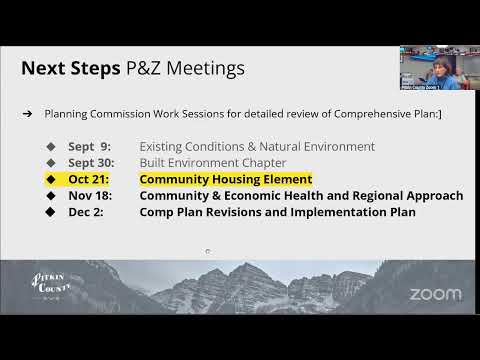
Staff closed by outlining next steps: additional PNZ work sessions (including Nov. 18), compiling public feedback into a final draft in late winter (January–February 2026), referral to caucuses and municipalities, and subsequent Planning & Zoning and Board of County Commissioners hearings. Staff also noted that code updates and implementation steps would follow in 2026.
The commission did not take formal votes during the session; staff asked PNZ members for guidance and clarification to revise the draft policies and implementation priorities.
The county will return a revised set of policies and suggested implementation actions to PNZ in upcoming meetings; code amendments and more detailed implementation plans are expected to follow after the draft plan is finalized.