
Board debates JBAA restroom regulation options; leans toward balanced approach with parent notification
Get AI-powered insights, summaries, and transcripts
Subscribe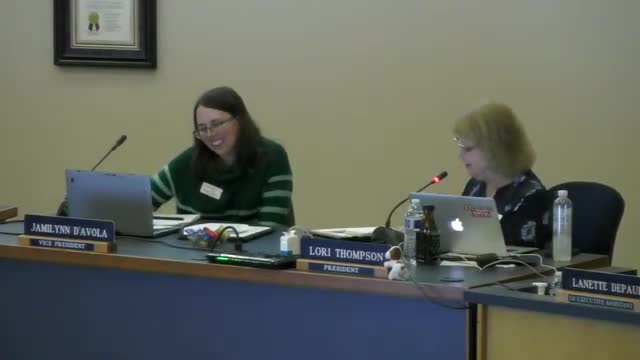
Summary
Board members and staff debated a proposed JBAA regulation for access to sex‑designated restrooms at District 49 on Oct. 23 and signaled consensus toward a ‘balanced’ approach that preserves dignity, avoids intrusive verification and adds parent notification for student accommodation requests.
The District 49 board spent more than an hour on Oct. 23 debating a proposed regulation (JBAA–R) to implement Policy JBAA, which would regulate access to sex‑designated restrooms and related facilities. Legal counsel, administrators and board members discussed five variables in the draft regulation — how to determine a biology/facility match, reporting protocols for alleged violations, investigation protocols, consequences for verified violations, and processes for accommodation requests.
Scope and complexity: Legal counsel and staff stressed the regulation’s complexity because it must address five distinct populations (District 49 students, District 49 staff, district guests, adult visitors, and students visiting from other districts) and different time/place constraints for enforcement. Administrators noted enforcement is most practical during the school day and co‑curricular activities; events open to the general public present verification and consequence challenges.
Options considered: The draft offered three implementation styles for many sections — a structured option (proactive verification and monitoring), a balanced option (honor-system access with targeted verification and response), and a variable/toothless option (minimal structure). Board members expressed concerns about intrusive verification (for example, camera installation or routine checks of birth certificates) and about creating unreasonable monitoring burdens on staff. Administration proposed a practical technical solution sometimes called the “airplane‑style” lock (vacant/occupied indicator) for single‑occupant toilets as a limited capital option if needed.
Accommodation requests and parent notification: Section 5 (accommodations) drew particular debate. After discussion — including concerns about staff restroom access, safety in single‑stall spaces, and the low historical frequency of accommodation requests — the board signaled consensus for the balanced option (option B) with edits: student accommodation requests will be routed through the building administrator (a single officialised path rather than only a counselor), requests can be made confidentially in good faith without mandatory supporting documentation, and parents will be notified when a student requests an accommodation. Administration was asked to redraft Section 5 to incorporate those edits.
Reporting and investigation: The board and administrators discussed whether only district employees should be able to file formal reports that generate an official, logged investigation (the administration recommended limiting formal reports to trained district employees to avoid anonymous or malicious claims). The board asked staff to redraft the reporting language to clarify that individuals can make allegations to staff but that only vetted, substantiated complaints become formal reports that trigger documented investigations, and to provide training/ protocols guidance.
Consequences and scope: Board members debated progressive discipline approaches and cautioned against making suspension or expulsion the initial response. Administration advised starting with warnings (documented) and escalating only for repeated or defiant behavior, noting that expulsion is an elevated response appropriate only for serious or persistent misconduct and is constrained by statute and due-process requirements.
Outcome and next steps: The board reached a working consensus to pursue the balanced approach for multiple sections and tasked administration and legal counsel to: (1) redraft Section 5 (accommodations) to reflect parent notification and a single administrative request path; (2) revise reporting language so external allegations are vetted by staff before becoming formal reports; and (3) prepare suggested signage and a revised draft regulation for a future action item. Board members emphasized implementation practicality — such as selectively installing occupancy locks where requested and ensuring camera placement is never inside restroom spaces — and requested additional background on investigative protocols and comparable installations before final action. No formal vote was recorded in the provided transcript excerpt; the item was set for further administrative revision and future board action.
Why it matters: The regulation would change operational practices across schools and has legal and civil‑rights implications. The board’s choice affects school access, privacy protections and how the district responds to complaints and accommodation requests.