
Groundwater, leachate and well‑monitoring highlighted in Coffin Butte expansion review
Get AI-powered insights, summaries, and transcripts
Subscribe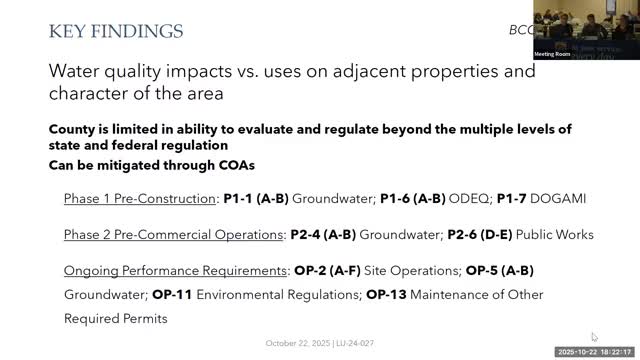
Summary
County staff and hydrogeology consultants told the board the expansion will require preconstruction baseline groundwater monitoring (two years), permits from DOGAMI/DEQ and ongoing sampling; the applicant agreed to baseline sampling and to offer testing of nearby domestic wells.
Groundwater and leachate concerns were a major topic on Oct. 22 as Benton County staff and applicant consultants described proposed preconstruction and ongoing conditions intended to protect wells and springs near the Coffin Butte expansion area.
County staff and Republic Services’ hydrogeology consultants described a phased approach that begins with two years of baseline groundwater monitoring and chemical sampling before any ground‑disturbing activity in the expansion cell. Staff said that baseline data are necessary to evaluate any future change in groundwater levels or chemistry and would form the basis for enforcement if impacts occurred during construction or operations. The staff report and conditions require applicants to provide DOGAMI and DEQ permits prior to excavation.
John Howard (Geologic Associates), who testified for the applicant’s consultant team, said monitoring already addresses on‑site monitoring wells (arsenic and other constituents) twice a year and that private domestic wells south of the landfill could be added to the monitoring program at residents’ election. As he explained, groundwater south of the landfill is generally upgradient relative to the proposed expansion area; staff said upgradient wells provide baseline protection for detecting change.
The conditions staff proposed would require the applicant to document the bottom elevation of excavations relative to the water table and to justify any excavations with site‑specific hydrogeologic data. Staff noted DEQ’s primacy over chemical water quality standards but said the county can enforce land‑use conditions tied to groundwater monitoring and can revoke land‑use approval if required conditions, permits or monitoring are not met.
Residents and opponents raised questions about springs on Tampico Ridge and about the permanence of groundwater changes if blasting or excavation connects to fractured basalt conduits. One adjacent landowner described springs used for livestock and said loss of spring flow would be a permanent and significant change. Staff responded that conditions requiring baseline data, ongoing monitoring during construction and a DOGAMI pre‑excavation permit are intended to identify and prevent those outcomes, and to provide a basis for enforcement if impacts occur.
Key technical details in the record: baseline monitoring for two years prior to excavation, monitoring of site monitoring wells twice per year (applicant), offer to sample nearby domestic wells for arsenic at least once a year if residents request it, and a requirement to demonstrate minimum separation between excavation bottom and the water table. Staff said that continued monitoring would occur through construction, commercial operations and closure.
No decision was reached; the board continued the hearing to Nov. 4 and asked staff and the applicant to clarify monitoring protocols and reporting mechanisms to private well owners.