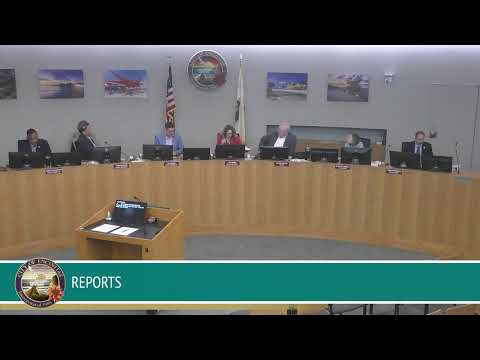
City council approves staff proposals for four Caltrans HSIP safety projects, with design changes and conditions
Loading...
Summary
Encinitas City Council on Oct. 22 authorized staff to apply for Caltrans Highway Safety Improvement Program Cycle 12 grants and approved preferred design directions for four safety projects — protected bikeways on Encinitas Boulevard and El Camino Real, a Cardiff/Solana Beach pedestrian crossing, and Coast Highway 101 pedestrian/bike improvements — while adding specific design and construction conditions.
Encinitas City Council on Oct. 22 authorized staff to apply for Caltrans Highway Safety Improvement Program (HSIP) Cycle 12 grants and approved preferred design directions for four safety projects: a protected bikeway and buffer upgrades on Encinitas Boulevard; protected bikeway geometry and a protected intersection concept at El Camino Real and Santa Fe Drive; a high-visibility pedestrian crossing at the city’s border with Solana Beach; and pedestrian/bicycle improvements along South Coast Highway 101 in Cardiff.
The council voted unanimously to proceed with the grant applications and gave staff direction on specific cross-section preferences and temporary construction measures. Traffic staff and the consultant team presented concept designs and said the Caltrans grant awards require ‘‘protected bikeway’’ countermeasures (flexible posts or equivalent) for some projects but give staff some latitude during final design and scope-change requests.
Why this matters: The projects aim to reduce crashes, shorten crossing distances for pedestrians and bicyclists and improve multimodal access to schools, beach areas and commercial corridors. HSIP grants cover a majority of construction costs but require a local match; by approving concept direction tonight the council preserved the city’s ability to seek up to 80% federal/state construction funding under the Caltrans program.
Council and staff emphasized the projects’ differences and tradeoffs. For Encinitas Boulevard (Kelly Magdalena/Via Cantabria corridor) staff recommended widening bike lanes and buffers, adding turn pockets at Saint John school area and installing flexible posts where buffers are wide enough. Council approved the staff-preferred configuration but directed staff to minimize the number of flexible posts where possible and to design turn pockets to address existing congestion.
At El Camino Real and Santa Fe Drive council chose an alternative described as the more conventional protected bikeway layout (labeled Alternative B in staff materials). Council members requested additional design work: add a protected refuge island on the north side of the intersection, test a bike/ped signal or delayed signal phase to reduce right‑hook conflicts, and evaluate bulb‑outs and a southwest corner curb modification to shorten crosswalks. Council also asked staff to preserve El Camino Real travel lane width and to use the grant for the protected bike lane work while using city funds and future design steps to develop a fuller protected intersection if needed.
The Cardiff/Solana Beach pedestrian crossing located at the city border — proposed in staff materials as either a rectangular rapid‑flashing beacon (RRFB), a rectangular rapid flashing beacon with refuge or a full signal — was deferred. Solana Beach staff requested time to coordinate designs with Encinitas; Caltrans indicated in writing the delay would not jeopardize award timing. Council directed staff to continue coordination with Solana Beach and to return to council Nov. 12 with a recommended alternative that aligns both cities’ plans.
On South Coast Highway 101 (Cardiff Reef to Cardiff State Beach), council approved a preferred option that moves the main shared pedestrian/bike facility to the west (ocean) side and creates a two‑way protected cycle track there, while removing many of the existing wheel stops and minimizing flexible posts. Council asked staff to remove curb‑type wheel stops where feasible and to retain limited, widely spaced flexible posts for visual separation only if required by the grant or safety analysis.
Public comment was robust: advocates for protected intersections and shorter crossing distances urged designs that remove vehicle/bike conflict points; some speakers cautioned about safety data for some separated facilities and urged careful engineering. City traffic staff and consultants said concept designs are preliminary and that detailed traffic analysis, community engagement and multiple public hearings will follow if the city is authorized to proceed by Caltrans.
Next steps: Staff will submit the HSIP Cycle 12 applications within the Caltrans deadlines and, pending any awards, will return to council with design packages and cost estimates for construction authorization and to identify local matching funds. Caltrans typically requires a later ‘‘authorize to advertise’’ step during which design details and final scope are reviewed before construction funding is released.
Votes at a glance: Encinitas Boulevard protected bike lane (preferred concept) — approved unanimously; El Camino Real/Santa Fe intersection (preferred alternative B and design directions) — approved unanimously, with direction to add refuge island, evaluate signal phasing and consider corner bulb‑outs; Cardiff/Solana Beach crossing — continued to Nov. 12 for additional Solana Beach coordination; South Coast Highway 101 (Cardiff) preferred alternative B — approved unanimously with instruction to minimize wheel stops and allow traffic engineer discretion on temporary no‑parking during construction.
Council requested that final designs include clear documentation of where flexible posts are required for grant compliance, an assessment of signal phasing options at Santa Fe/El Camino, and construction‑phase traffic controls to protect neighborhoods during building activities.