Get Full Government Meeting Transcripts, Videos, & Alerts Forever!
Get email alerts on the Firearm Detection Ai topic
No spam. Unsubscribe anytime.
ZeroEyes tells Michigan subcommittee its camera-based AI flags brandished firearms, keeps footage off cloud
Summary
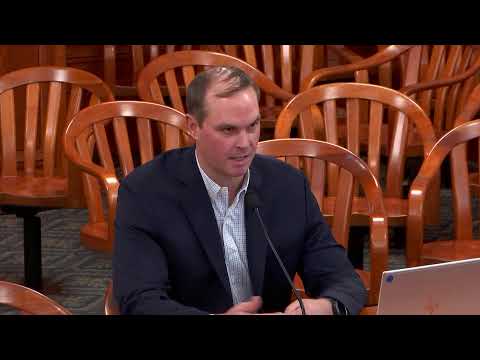
Kieran Carroll, chief strategy officer at ZeroEyes, told the Michigan House Oversight Committee’s Subcommittee on Homeland Security and Foreign Influence on Sept. 12 that the company’s software detects visible, brandished firearms in existing security-camera feeds and delivers a brief validated image and metadata to trained analysts and public-safety endpoints rather than streaming live video off customer networks.
Kieran Carroll, chief strategy officer at ZeroEyes, told the Michigan House Oversight Committee’s Subcommittee on Homeland Security and Foreign Influence on Sept. 12 that the company’s software detects visible, brandished firearms in existing security-camera feeds and delivers a brief validated image and metadata to trained analysts and public-safety endpoints rather than streaming live video off customer networks.
Carroll said the company’s commercial product “is doing right now is detecting a visible brandished firearm,” and that ZeroEyes does not perform facial recognition, behavioral profiling or broad video streaming. He said the AI runs on a customer’s network, sends a single keyframe image and metadata if the model flags a firearm and a ZeroEyes analyst validates the detection before any alert leaves the customer system. “We don’t have the ability to look into live video,” Carroll said.
The company’s presentation included examples it said led to arrests or law-enforcement responses in municipalities and school districts, and described recurring patterns such as “social media flexing” — students filming themselves with weapons — and gang-related staging and escalations. Carroll said ZeroEyes operates a 24/7 analyst center, integrates validated detections to dispatch through partners such as RapidSOS, and processes large volumes of frames: “We in person on about 3,000,000,000 frames of video a day,” he said.
Why it matters: lawmakers and school officials are weighing technology that can speed responses to visible weapons while raising privacy and procurement questions. Committee members asked about false positives, data retention and third-party audits; Carroll described one widely discussed false positive at a Texas high school and said district procedures determine how alerts are escalated.
Key operational details presented to the subcommittee included: - Detection scope: ZeroEyes’ commercial deployment is limited to visible, brandished firearms and (soon) visible knives; the company explicitly does not seek to detect concealed or holstered weapons or perform facial recognition. - Managed-service model: AI runs on the customer’s network; when the model flags a frame the system transmits a single keyframe image (with a timestamp and geolocation) to ZeroEyes’ analyst team for rapid human validation. Carroll said that approach reduces bandwidth and privacy exposure compared with streaming video to the cloud. - Integrations and endpoints: validated detections can be routed to mass-notification platforms, law enforcement common operating pictures and directly to 9-1-1 through RapidSOS, Carroll said. - Data retention and custody: Carroll said customer video remains owned by the customer; ZeroEyes retains keyframe alerts by default for about 30 days and retains true-positive evidence longer when required for law enforcement or prosecution. He said the company maintains SOC 2 and ISO-type security practices and runs red-team testing. - Performance and validation: Carroll said ZeroEyes has pursued Department of Homeland Security Safety Act review and that DHS receives aggregate, scrubbed performance data as part of validation. He said the company built proprietary datasets in its own lab rather than web-scraping images and that it has raised institutional equity capital (about $80 million, he said).
Committee members pressed for auditable performance and transparency. Representative Shriver asked for independently verified false-positive and false-negative rates in K-12 deployments; Carroll said DHS Safety Act review and the company’s published material provide such metrics and that ZeroEyes has had “1 detection turn into a false positive” that led to a brief school lockdown in Texas and subsequent local review. Carroll said the company would consider third-party audits and disparate-impact checks if a technically competent reviewer were agreed upon.
Vice Chair Mehrman and other members raised supply-chain and data-origin concerns. Carroll described the company’s policy of building proprietary datasets in the U.S., hiring primarily U.S. citizens for sensitive roles and avoiding third-party data brokers he said often source labeled images from overseas. Carroll warned of national-security risks when vendors procure third-party labeled data from actors tied to the People’s Republic of China and urged stronger procurement standards for public-sector networks.
Carroll also outlined policy touchpoints he said are relevant to states and school districts: updating definitions in school-safety grant language (COPS/SVPP), adding security-focused AI exemptions in state AI laws, and strengthening procurement standards such as FedRAMP-like reviews for systems that integrate to public-safety networks. He said ZeroEyes is working with federal agencies and that many states, including Michigan, have begun or may consider grant language and funding to help districts adopt such tools.
The subcommittee concluded its meeting after an unrelated procedural motion: Representative Meerman moved to approve the minutes of the committee’s Sept. 17 meeting; with “no objections,” Chair Brock declared the minutes approved.
The presentation and Q&A ran most of the meeting and included questions on retention policy, what constitutes a validated alert, who controls camera networks, and whether the company would accept regular third-party audits. Carroll said districts set escalation procedures; some districts ask for immediate law-enforcement notification, while others request lower-touch notification such as email or phone. “De-escalation is our number one priority at the company,” he said.
The subcommittee did not take further action on procurement standards, auditing requirements or statewide policy changes during this session, but members expressed interest in follow-up information about model performance, procurement safeguards and how school safety funds could be used for sensor and analytic upgrades.
Votes at a glance: Representative Meerman moved to approve the Sept. 17 minutes; the motion was approved by unanimous consent with members present at the roll call raising no objections.
Ending: Committee members thanked Carroll for the briefing and his military service and closed the meeting after approving the minutes by unanimous consent.