
Westford to field-test three elementary science programs, trial OpenSciEd at middle schools
Get AI-powered insights, summaries, and transcripts
Subscribe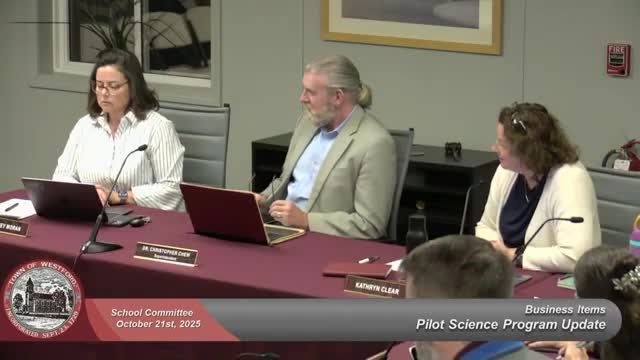
Summary
Westford Public Schools trustees heard details on a multi-stage pilot of elementary and middle school science curricula and a proposed phased rollout to align instruction with new state assessments.
Westford School Committee members on Oct. 21 heard a detailed plan to pilot three elementary science curricula and to field-test OpenSciEd units at the middle school level, with staff proposing recommendations to the committee in spring 2026.
The pilot will involve 14 elementary teachers testing three different K–5 programs — TWIG, Experience Science (Savvas), and OpenSciEd’s elementary materials — and middle school teachers will field-test one or two OpenSciEd units starting in January, officials said. "This year, we have 14 elementary school teachers that will participate in a pilot," said Dr. Julie Kelly, K–5 STEM curriculum coordinator. "All 14 teachers are going to try 3 different programs."
The goal is to compare instruction, student work and cost and to give teachers professional development and planning time before the district makes any purchase decision. "We're going to do 1 unit with the program that we currently have, TCI, then 1 unit with each of the other resources we're gonna try," Kelly said. Teachers who complete the pilot will be eligible for university credit as compensation for extra preparation, she added.
Nut graf: District leaders framed the review as a response to national and state shifts in science instruction and assessment. They said the pilot is intended to increase students' hands-on engagement and to prepare students for upcoming changes to the state science MCAS, which will emphasize modeling and simulation-based assessment tasks.
Dr. Chris Jeffcoat, the district’s 6–12 STEM coordinator, said OpenSciEd was already the middle school curriculum identified in last year’s review and that its open-source model allows the district to phase in materials and training over two to three years. "Instead of doing a pilot, we're going to field test either 1 or 2 units depending on what the teachers will commit to, and that would probably start in January," Jeffcoat said. He described OpenSciEd as research-validated and noted that teacher training is key to successful implementation.
Committee members asked about the balance between virtual labs and hands-on experiences. "Do not replace hands on learning with virtual simulations," Kelly said, summarizing state guidance; "the simulations come naturally to the students when they've experienced science with their hands and their eyes." Jeffcoat added that the combination of hands-on labs, simulations and transfer tasks helps students apply scientific ideas to real-world contexts.
Officials said vendors have offered kits and some professional development at reduced cost for the field tests. District staff explained that kits have two cost layers: durable one-time purchases (equipment that lasts) and consumable refill kits. One vendor under discussion would provide kits for the field tests at no cost and supply teacher-friendly, QR-coded set-up guides.
The committee did not vote on a purchase. District staff said they will collect teacher feedback, student work samples and cost estimates from the field tests and return with recommendations in the spring. The presenters repeatedly emphasized teacher agency in rollout and recommended a phased approach so training and materials costs can be spread over time.
Ending: The proposal positions Westford to align classroom practice with the state's shift to modeling- and phenomenon-based science instruction. The district will return to the committee with pilot results and a recommended implementation plan in spring 2026.