Get Full Government Meeting Transcripts, Videos, & Alerts Forever!
Get email alerts on the Solar Energy Code Amendment topic
No spam. Unsubscribe anytime.
Planning commission advances Title 17 amendments on solar farms and rooftop arrays after debate over community‑scale provisions
Summary
The City of Danforth Planning Commission on Oct. 14 approved proposed amendments to Title 17 (ORD 25‑02) to regulate solar farms as principal uses and to set standards for accessory freestanding and rooftop solar arrays, removing a proposed ‘community‑scale’ principal‑use category for now and adding site, maintenance, decommissioning and battery‑s
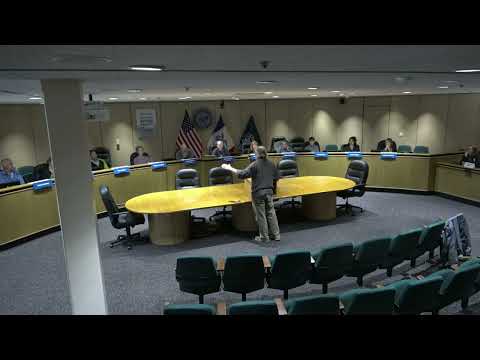
The City of Danforth Planning Commission on Oct. 14 moved forward a set of proposed amendments to Title 17 of the Danforth Municipal Code (ORD 25‑02) to regulate solar installations, including utility‑scale solar as a principal use and freestanding and building‑mounted solar arrays as accessory uses. Commissioners voted in favor of advancing the proposed code changes by roll call.
Planning staff presented a redrafted use matrix and new standards after council and commission feedback. Matt Wordridge, planning staff, said the revision removes “community‑scale” as a principal use for the time being and treats any solar project proposed as a principal use as a utility‑scale solar energy system regardless of acreage. Wordridge said the change was intended to allow the commission and council to advance more parts of the code while pausing consideration of broader community‑scale allowances until regulators and policymakers are ready.
Key provisions in the draft ordinance described by staff include: anti‑reflective coatings on panels and a requirement for third‑party glare studies to demonstrate that glare is minimized or eliminated on adjacent properties; a view‑shed or visual impact analysis where solar installations are adjacent to residential districts and screening requirements using trees, shrubs or other planting where appropriate; maintenance plans requiring repair or replacement of damaged components within 12 months and a decommissioning plan requiring removal of arrays, foundations, private roadways and other elements constructed for the facility; and siting restrictions that prohibit installations inside special flood hazard areas.
The draft sets detailed rules for building‑mounted systems: on pitched roofs, panels may rise up to 18 inches above the roof plane; on flat roofs a setback of 1 foot for every 2 feet of panel height is required, and panels shall not exceed 6 feet in height on structures 40 feet or less; panels on structures over 40 feet shall not exceed 15 feet in height. Wall‑mounted panels may project up to 2.5 feet and must be architecturally integrated.
Freestanding accessory systems in residential districts (except multi‑family of three units or more) are limited to rear yards on double‑frontage lots and must be no taller than 10 feet and no larger than 50% of the building footprint or 720 square feet, whichever is greater. Freestanding systems over parking lots are permitted subject to parking‑area standards and vertical clearance requirements.
On battery energy storage systems (BESS) accessory to utility‑scale solar, staff said proposed standards include set backs (transcript cites 200 feet from property lines and water bodies and a setback described as “2 500 feet” from buildings; staff indicated these distances are part of the proposed draft), a requirement that BESS be secured from public access, and separate maintenance and decommissioning plans for batteries. Staff said the fire marshal’s regulations and fire code will govern hazardous‑material and secondary‑containment requirements; the draft prohibits BESS as an accessory use unless the fire marshal grants permission.
Wordridge said approvals tied to principal‑use solar would be processed as special uses and reviewed by the zoning board of adjustment; many of the required plans — maintenance, screening, decommissioning and battery plans — will be submitted to and approved by the zoning administrator, a staff position appointed by the director. Commissioners asked clarifying questions about responsibility for enforcement, the role of the fire marshal and how certain measurements are calculated; staff said the fire marshal will have authority to order removal or remediation if life‑safety concerns arise.
After discussion, the commission moved and approved the proposed Title 17 amendments as presented for further processing (ORD 25‑02); the motion carried on a roll call with all recorded members voting yes.