Get Full Government Meeting Transcripts, Videos, & Alerts Forever!
Get email alerts on the State Legislation topic
No spam. Unsubscribe anytime.
Assemblymember Schultz, lobbyists outline housing, public‑safety and budget bills in Glendale update
Summary
Assemblymember Nick Schultz and legislative advocates reviewed bills from the 2025 session, including major housing and public‑safety measures, and discussed funding opportunities and the state’s regulatory environment for local jurisdictions.
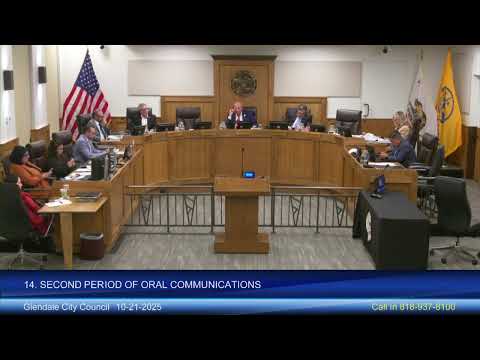
Glendale — Assemblymember Nick Schultz (40th Assembly District) and legislative advocate Kira Ross briefed the Glendale City Council on Oct. 21 about key bills from the 2025 legislative session, funding wins for the district and priorities to watch in 2026.
Schultz summarized a broad package of legislation his office advanced, emphasizing environmental protection bills that would expand state protections in the event federal safeguards were reduced, and several public‑safety measures that were a focus this year. He described AB 379 — a sweeping human‑trafficking reform that expands felony charges and establishes a survivor support fund from fines and state enforcement responsibilities — as a major lift with local impacts that would, among other things, give law enforcement earlier authority to intervene in some solicitation situations.
Schultz also reviewed bills aimed at housing production and infrastructure. He highlighted AB 1050 as a measure intended to unlock opportunity sites by lifting certain covenants, conditions and restrictions (CC&Rs) that prevent redevelopment of under‑used commercial parcels for housing. He said AB 361 — a bill related to procurement practices for school districts — would allow Glendale Unified to consider best‑value criteria beyond lowest responsive bidder on select pilot projects. Schultz noted he did not support SB 79 (a statewide zoning/density change) because, he said, it allowed densification in areas mapped as very high fire hazard severity near transit stops; he described concerns about fire safety and local infrastructure capacity.
Kira Ross of Emmanuel Jones and Associates, the city’s legislative advocate, provided a summary of the full session. Ross said the governor signed the bulk of bills sent to his desk this year but vetoed several pieces he found costly or duplicative. She highlighted two budget “trailer” bills (AB 130 and SB 131) that make significant changes to CEQA procedures for qualifying infill projects, a six‑year moratorium on some building standard changes, and additional funding flows for homelessness services tied to Proposition 4 allocations. Ross also noted expansion of the state’s film and television tax credits and AB 91 — the MENA Inclusion Act — which the city supported and which requires better demographic data collection.
Council questions and themes
Council members used the presentation to press for follow‑up on Glendale’s local priorities in Sacramento, especially funding for parks, public safety and services associated with housing growth. Several council members asked Schultz to pursue more “carrots” — not only statewide mandates — for jurisdictions that have already met housing targets or are investing in local parks and infrastructure. Schultz said he would maintain contact with the city on its budget request and encouraged use of online constituent tools that most rapidly reach him when bills are on the Assembly floor.
SB 79, which drew numerous public comments to the dais and to the assemblymember, remained a flash point. Schultz said he had not supported the final version due to local fire‑safety concerns in parts of his district and that he had abstained rather than vote “no” to preserve no‑vote leverage for other issues.
What council members and staff will do next
Ross told the council staff that state funding opportunities tied to Proposition 4 are already being circulated to city departments, and that staff should continue to monitor trailer‑bill rules and grant application windows. Council members asked staff to keep their Sacramento advocates apprised of updated local priorities and to schedule a fall or winter planning review to align city requests with the governor’s budget calendar.
Why it matters
The briefing reiterated how state policy — from CEQA to density bonus and procurement law — shapes the range of actions available to cities. Council members said they will continue pressing for funding mechanisms that reward local investment in parks, emergency services and affordable housing, rather than relying solely on top‑down mandates.
Speakers quoted or referenced: Assemblymember Nick Schultz; Kira Ross, Emmanuel Jones and Associates.