Get Full Government Meeting Transcripts, Videos, & Alerts Forever!
Get email alerts on the Data Centers topic
No spam. Unsubscribe anytime.
Amazon seeks conditional-use approval for large data‑center campus in Louisa County; residents raise water, noise and traffic concerns
Summary
Amazon representatives presented a concept plan for a multi‑phase data center campus in Louisa County’s Mineral voting district at a neighborhood meeting June 2, seeking a conditional‑use permit, special exceptions and a waiver of certain Technology Overlay District standards; no formal approvals were made at the meeting.
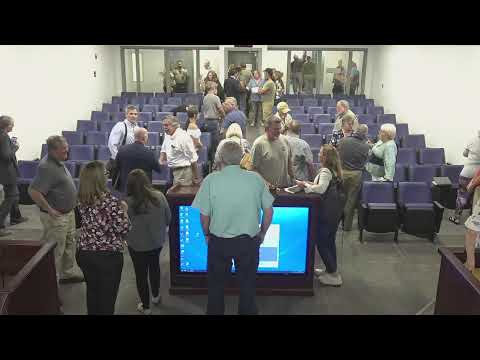
Amazon representatives presented a concept plan for a multi‑phase data center campus in Louisa County and answered questions at a neighborhood meeting organized by the county’s Community Development Department.
Tom Eglin, deputy director of Louisa County’s Community Development Department, opened the meeting and described the process for the proposal, saying, “My name is Tom Eglin. I am the deputy director for Louisa County's community development department, and you are here because you received this letter.” Eglin explained that tonight’s meeting was informal and that the county’s Planning Commission and Board of Supervisors would review any formal application later in the entitlement process.
Logan Brunette, a land‑use attorney representing Amazon, described the permits submitted to the county. Brunette said the June 2 application requests a conditional‑use permit to allow a data‑center campus with utility major service and accessory uses, special exception permits for several access points, and a waiver of certain Technology Overlay District standards for perimeter buffering and setbacks adjacent to tax map parcel 4275 A. He said the proposal covers “a little under 1,400 acres” and could include up to 7,200,000 square feet of data‑center facilities with seven electrical substations.
Stephanie Momon, with Amazon’s real estate and land development division, said the company is proposing a phased development and described elements of the concept plan. She said Amazon intends to preserve mature vegetation where possible and showed an illustrative plan that the team said keeps about 64% of the property as open space. Momon described proposed buffers of “200 to 300 feet” and said the nearest proposed data‑center building would be about 850 feet from the closest residence. On water she said the campus would use evaporative cooling and that Amazon plans to implement rainwater harvesting and “build storage tanks next to a lot of these data centers” to reduce demand on public raw water supplies.
Amazon representatives provided the applicant’s economic estimates from an independent consultant: roughly 30 direct jobs per 250,000 square feet of data‑center space and potential county revenues the presenter said “could generate up to a $115,200,000 per year for the county” at full build‑out. The team said the project would be built in phases and that infrastructure improvements, including electric upgrades, would be coordinated with utilities and paid for by the developer as part of serving the site.
Residents and others who spoke raised a range of concerns. Water supply and cooling was the most frequent issue. One resident asked about a cited figure of “660,000 gallons a day” and how the project would affect private wells. Momon replied that the project team will work with the county’s water authority and that rainwater harvesting would be used to reduce reliance on public raw water; she also said the project has no planned on‑site wells at this time.
Other questions focused on the electric grid, noise, traffic, construction impacts and the timing of benefits cited by the applicant. David Rogers, a candidate for the Board of Supervisors for the Mineral district, asked whether the county’s power grid could sustain multiple large data centers and warned of “blackouts and brownouts.” Brent Whitlock said his electric co‑op had notified customers of a pending $7–$15 monthly increase and asked whether local residents would bear higher bills. On noise, resident Terry Zamsky said he records about 50 dB at his back deck now and asked that levels be maintained; Amazon representatives pointed to county noise limits (cited in their remarks as 65 dBA daytime, 60 dBA nighttime) and said sound enclosures, walls and landscaping are part of their mitigation toolkit.
Traffic and construction logistics drew sustained questioning. Residents said local roads are narrow, include blind turns and carry school buses; they asked how heavy construction traffic would be routed and mitigated. Amazon said it will submit third‑party traffic impact studies to VDOT and the county and that construction mitigation plans would be developed for each phase to disperse traffic and consider school hours.
Other items raised by residents included: whether the project’s stormwater controls would protect Northeast Creek Reservoir (several speakers identified that reservoir as the local raw‑water source and said it has been under drought restrictions); whether data‑center facilities would seek tax exemptions or otherwise reduce the expected local revenue; the potential need for on‑site diesel backup generators and their noise; impacts to property values; wildlife and habitat loss; and cumulative effects, given two other data‑center campuses already proposed or under construction nearby.
County staff and the applicant repeatedly emphasized the current stage of the process. Eglin said the meeting is part of the entitlement process and that the Planning Commission and Board of Supervisors will have opportunities to accept public comment. Brunette and Momon said more detailed engineering (geotechnical borings, traffic studies, stormwater design and final site plans) will follow and that many project elements are not final at the concept stage.
No permit decisions or votes were taken at the meeting. The neighborhood meeting is a pre‑application/entitlement discussion; the applicants submitted materials to the county on June 2 and the application is under review. Tom Eglin said staff will include notes from this meeting in a staff report to the Planning Commission.
Residents seeking more detail were advised to contact county staff. Eglin and the applicant offered to continue one‑on‑one conversations and to provide contact information for county economic development and technical reviewers.
Ending: The meeting closed without formal action; participants were asked to leave the room to allow the Louisa County Water Authority to use the venue, and staff said they would remain available after the meeting to answer questions.