Get Full Government Meeting Transcripts, Videos, & Alerts Forever!
Get email alerts on the Building Standards topic
No spam. Unsubscribe anytime.
Oxnard Council to introduce ordinance adopting 2025 California building standards with local amendments
Summary
City staff recommended the Oxnard City Council introduce an ordinance to adopt the 2025 California building standards and related property maintenance codes, with local amendments addressing seismic safety, wildfire mitigation and localized drainage; the state codes take effect Jan. 1, 2026.
The Oxnard City Council was asked to introduce an ordinance to adopt the 2025 California building standards and related property maintenance codes, with local amendments tailored to Oxnard’s seismic, wildfire and drainage conditions.
Jeff Bengali, Oxnard’s community development director, told the council the state updates the model-based codes every three years and that the 2025 package will take effect Jan. 1, 2026. "This update to the building standards codes will become effective 01/01/2026," Bengali said during the presentation.
Bengali said the state package includes the California Building Code, California Residential Code, California Green Building Standards Code (CalGreen), California Historical Building Code, and other specialty codes — and, for 2025, the California Wildland-Urban Interface Code. He described the wildland-urban interface code as "a code that has taken different sections from the fire code and the building code as they pertain to wildfire protection and put them into its own separate code."
The staff recommendation presented to council was that the body "introduce and approve by first reading, by title only, waiving further reading of an ordinance" amending multiple articles to adopt the listed California codes and the International Property Maintenance Code and the Uniform Code for the Abatement of Dangerous Buildings. The transcript does not record a vote or final action on that recommendation.
Bengali described the legal and technical basis for the city’s proposed local amendments. He said local amendments are allowed for administrative reasons and for technical adjustments that must be based on climatic, geologic or topographical conditions. He cited Oxnard-specific factors as examples: Santa Ana wind events and wildfire exposure, high seismicity, a high groundwater table, electrical power reliability concerns that affect backup systems such as fire pumps, and Oxnard’s generally flat topography that can create localized flooding. "We have amendments to enhance seismic safety," Bengali said, and the city proposes lot drainage and minimum foundation elevation standards "to help prevent localized flooding."
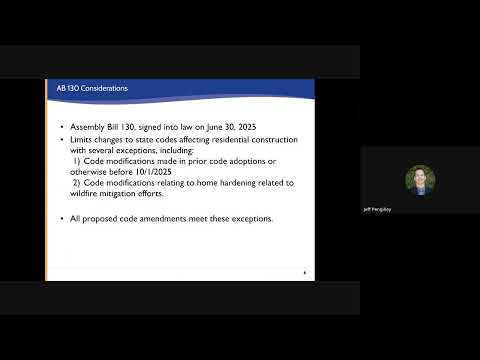
On state limits to local amendments, Bengali addressed Assembly Bill 130 (AB 130), saying the city’s proposed changes fall into two exceptions described in the law: modifications made in prior code adoptions before Oct. 1 and code changes related to home hardening for wildfire mitigation. "All of the amendments we're making are amendments that we've had in prior code adoptions," he said. Bengali added that some amendments have been relocated in the reorganized state code text but are not new.
Bengali also said staff trimmed provisions that do not apply locally — for example, hurricane-resistance provisions — to make the local code easier to follow. He said the city will adopt provisions from the new Wildland-Urban Interface Code and the fire code and that the amendments will facilitate local enforcement consistent with Oxnard’s recently adopted fire hazard severity zone maps.
The presentation closed with Bengali noting the item was a routine administrative matter and that staff were available for questions. The transcript records Bengali’s recommendation and explanation but does not record council debate, any motion by a council member, or a recorded vote.
If the council proceeds as recommended, the ordinance would implement the 2025 California codes locally with Oxnard’s specified amendments; the state codes themselves become effective Jan. 1, 2026. The transcript does not specify the ordinance number, the agenda item ID, or a final adoption date for the local ordinance.