Get Full Government Meeting Transcripts, Videos, & Alerts Forever!
Get email alerts on the Council Votes topic
No spam. Unsubscribe anytime.
Council adopts multiple ordinances and resolutions, approves federal priorities and moves Safe Streets funding; several measures pass with split council votes
Summary
City council approved a package of budget, bond and administrative measures, adopted federal priorities and set project priorities for Safe Streets funding while several items produced split votes and substantive public comment.
What happened: At a regular Spokane City Council meeting, members considered and voted on a series of ordinances, resolutions, appointments and first readings. The council adopted federal priorities, approved bond refundings and several administrative policies, and took action on transportation and housing-related items. Some measures passed unanimously and others drew split 5-2 or 6-1 votes; multiple items also drew public testimony during the consent and regular agendas.
Votes at a glance (items taken from the legislative agenda and recorded vote results in the transcript):
- Special budget ordinance C 36 7 67 (amending C 36 6 26) to pay off the Golf Series 2018 S.I.L.P. loan. Outcome: passed, 7-0.
- Emergency ordinance C 36 7 64 authorizing issuance and sale of a limited tax general obligation refunding bond (not to exceed $340,000) to refund an outstanding limited tax GO refunding bond (Riverfront Park Iron Bridge taxable series). Outcome: passed, 7-0.
- Resolution 2025-83 approving the City of Spokane's 2025-2026 federal priorities (which include efforts to stop smuggling of illicit synthetic drugs, support for Medicaid and other federal requests). Outcome: passed, 7-0.
- Resolution 2025-84 (Spokane Safe Streets for All fund) setting council priorities for project selection under the fund. Outcome: passed, 6-1. Public commenters raised concerns about open drug markets near schools and urged quick build/adaptive safety measures; council debate highlighted both design solutions and the role of enforcement.
- Resolution 2025-85 (setting a hearing for 11/17/2025 on vacation of an alley between College Ave and Bridge Ave). Outcome: passed, 7-0.
- Resolution 2025-86 amending the city's administrative policy titled "Investments." Outcome: passed, 5-2. Councilmember discussion recorded reservations expressed by Councilmember Cathcart about increased investment risk; public comment criticized city spending priorities.
- Resolution 2025-87 establishing underwriting guidelines for the Spokane Internal Lending Program. Outcome: passed, 6-1.
- Resolution 2025-88 authorizing issuance and sale of limited tax GO refunding bonds (aggregate not to exceed $6,611,000) and related refinancing of interfund loans. Outcome: passed, 6-1.
- Resolution 2025-89 approving appointment of Trace Bradburn as director of Solid Waste for the City of Spokane. Outcome: passed, 7-0.
- Resolution 2025-77 regarding amendment of the City of Spokane water and hydroelectric rules and regulations for water-system installations (formal adoption of manuals used by the city). Outcome: passed, 7-0.
- Resolution 2025-78 adopting a public rule for the Wastewater Management Department Side Sewer Installation Handbook. Outcome: passed, 7-0.
- Resolution 2025-80 (deferred to hearings H1 earlier in the agenda and moved under hearings) renaming the Housing Local Sales Fund to the HEART Fund and amending related municipal-code sections. Outcome: passed, 5-2. Council discussion revealed a split on whether fund priorities should favor capital construction of new units vs. behavioral-health and services.
- Ordinance C 36 7 33 establishing the Affordable Housing Permit Fee Deferral Program (new chapter 8.21). Outcome: recorded vote in the minutes that resulted in approval (clerks' tally recorded in the transcript; the final count recorded in the transcript was taken as passed by the chair after a roll-call sequence).
- Ordinance C 36 7 51 granting Marathon Pipeline LLC a non-exclusive franchise to operate pipeline facilities in the public right of way. Outcome: passed, 7-0.
- Ordinance C 36 7 53 making technical corrections to multiple chapters of the Spokane Municipal Code. Outcome: passed, 7-0.
- Several first-reading ordinances (employee retirement provisions C 36 7 65; solid waste changes C 36 7 66; adoption of public rules C 36 7 52) were read for the first time and deferred for further action.
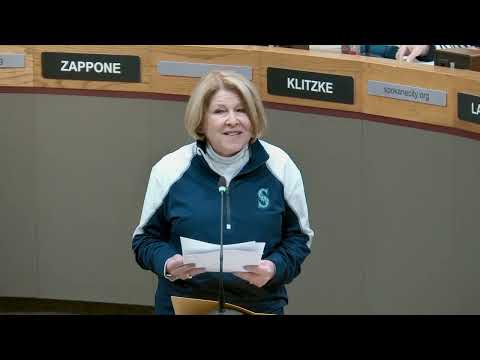
Context and council debate: Several agenda items produced public testimony, most frequently from a recurring city resident identified in the record as Larry Andrews, who raised concerns about perceived overspending, enforcement levels and officer staffing. Others who testified included Will Hewings (opposed to parts of the federal priorities resolution on grounds of public-safety concern), Diane Sutton (raising neighborhood drug-market concerns near schools), Will Quinn (landlord commenting on zoning and permit issues), and representatives of Spokane Reimagined and the Spokane Business Association who urged more quick-build safety and business support measures.
Several council members framed Safe Streets funding as a mix of quick-build and longer-term infrastructure investments rather than a substitute for enforcement; Councilmember Klitzke noted the need for both enforcement and engineering, and Councilmember Dylan described federal legislation supporting interdiction of synthetic-drug supply as a tool the city should include in its federal agenda.
What the record shows about outcomes and next steps: The council adopted the City's federal priorities and moved forward with several financing and administrative measures. The debate over the HEART Fund and the Affordable Housing Permit Fee Deferral Program reflects ongoing differences among council members about prioritizing capital housing production versus funding behavioral-health services and operating supports. Several first-reading items were deferred for later council action.
Quotation (example): "If we have those co-deployed teams out there helping with folks that are not committing crimes but are existing on our streets...then our police have more resources to be out there, working on more serious crimes," Councilmember Klitzke said in support of a co-responder model and the federal priorities.
Record note: The vote counts and ordinance/resolution numbers above reflect the roll-call and chair-reported tallies captured in the meeting transcript. For items where individual yes/no votes were not read aloud in the transcript, the article reports the final tallies recorded by the clerk and chair in the meeting record.